
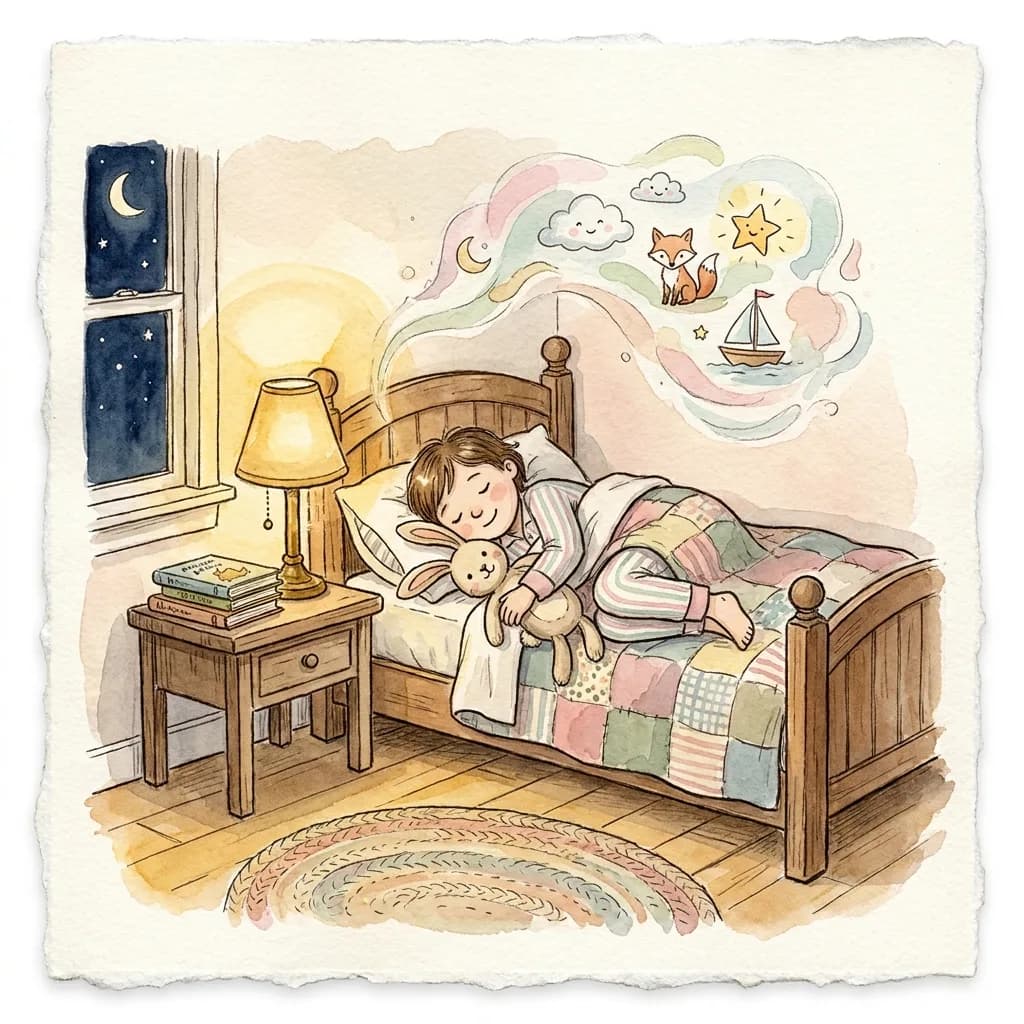
Bedtime Stories for Kids: What Makes One Work and How to Pick the Right One
Bedtime stories help kids sleep more, learn more, and settle faster, but only the right kind. Here's what the research actually shows, how to choose a story that lands at bedtime, and where audio fits in.
Why Bedtime Stories Still Matter
A bedtime story is the part of the day that's easiest to skip and the hardest one to replace. The bath has to happen. Teeth have to get brushed. The story is the one thing that survives only if a parent decides it does.
And plenty of nights, it doesn't. An Ipsos survey of American parents found that roughly 46 percent of kids aged seven and under most often have a bedtime story before sleep, with the rest defaulting to TV, prayer, talking, or nothing in particular Ipsos / Disney Storytime. A more recent HarperCollins survey found only around 41 percent of children aged zero to four are read to daily or nearly daily. The bedtime story is in a slow retreat against screens.
Which is a shame, because of all the small things you can do for a young kid's sleep and development, this one has the most research behind it. The catch is that not every story works at bedtime, and the wrong one can actively make the night harder. This is what the evidence says, and how to use it tonight.
What "For Kids" Means at Each Age
A bedtime story for a newborn and a bedtime story for a seven-year-old are two different objects. The label "bedtime stories for kids" covers a wide window where attention, vocabulary, and emotional range all change every few months. For the first year specifically, our guide to infant bedtime stories covers what to read when the story is mostly voice, rhythm, and routine. Once a child reaches preschool, our guide to stories for preschoolers to read sorts read-aloud picks by mood and length.
Useful starting ranges if you're picking from a library or writing your own:
- Ages 1 to 2: 2 to 4 minutes
- Ages 2 to 3: 3 to 5 minutes
- Ages 3 to 4: 5 to 8 minutes
- Ages 4 to 6: 8 to 12 minutes
- Ages 6 to 8: 10 to 15 minutes
The youngest end of the range is soft repetition, sensory language, mostly your voice carrying the weight. Past three, kids can follow a real plot start to finish if it's small. Past five, two characters and a longer arc become possible. The number isn't the point. The shape is.
These match how long young children can stay with a single focused activity. Beyond that window, most kids drift, fidget, or ask for water. Our deeper guide to short bedtime stories covers the length question by age and why short almost always wins at bedtime. For the youngest end of that window, bedtime stories for 2 year olds covers what works when the story is mostly your voice and the plot is optional. For three-year-olds specifically, bedtime stories for 3 year olds covers what kind of plot lands at that age, bedtime stories for 4 year olds covers what changes when imagination starts running hot, and bedtime stories for 5 year olds covers what changes at kindergarten age when a kid can hold two characters and a side plot.
The label matters less than the shape. A "kids' story" with a chase scene is not a bedtime story. A short, slow story about a frog finding their shell is. Once the story still works but the school-night clock needs to change, our 9 year old bedtime guide works backward from the morning wake-up.
What the Research Actually Says
The case for nightly bedtime stories is unusually well-supported for a parenting recommendation.
On sleep, a longitudinal study of more than four thousand families found that preschoolers with regular language-based bedtime routines, the kind that include reading, storytelling, or singing, slept about twelve minutes longer per night than those without and scored higher on standardized vocabulary measures at age five Hale et al., Sleep. Twelve minutes a night, every night, across two years, is a lot of sleep.
On brain development, a small fMRI study of preschool-aged children found that listening to stories activated regions of the left brain tied to semantic processing and mental imagery, and that kids with more reading at home showed stronger activation in those areas Hutton et al., Pediatrics. Listening kids are busy. They're building the pictures in their own head, which is a more active kind of attention than watching.
On the broader effect of a consistent routine, Jodi Mindell's international study of more than ten thousand families found a dose-dependent relationship between routine consistency and child sleep: more nights of the same routine, earlier bedtimes, shorter sleep onset, fewer night wakings, longer total sleep Mindell, Sleep 2015. The size of the effect grew with how often the routine actually happened. Mindell's takeaway across cultures was unusually direct: "It doesn't matter if you are a parent in the United States, India, or China. Having a bedtime routine makes a difference."
The American Academy of Pediatrics' 2024 literacy policy update recommends shared reading from birth through at least kindergarten as part of routine pediatric care, calling it one of the most evidence-backed things a caregiver can do for early development AAP, Pediatrics 2024. The recommendation is not new. The strength of it is.
How to Pick a Bedtime Story That Actually Lands
Most published "kids' stories" are written for the daytime. They build to a laugh or a punchline, throw in sound effects, and end on a beat that makes a child want to read it again right now. That's what works for a five-minute read at the kitchen table after lunch. It's the opposite of what works at 7:45 in the dark.
A bedtime story for any age tends to share a few traits:
- One main character and one small problem
- A calm arc that starts low and stays low
- A familiar setting like a bedroom or a garden or a forest path
- Sensory language that slows breathing
- A clear
- soft resolution before the last minute
- A narrator's voice that gets quieter toward the end
Skip at bedtime, regardless of how good the book is the rest of the day:
- Chase scenes and villains
- Sudden loud moments or big sound effects
- Cliffhangers or to-be-continued endings
- New characters introduced in the last minute
- Plot twists meant to surprise
If a story leaves your kid wired or asking what happens next, it was a good story for the wrong time of day. Luma the Little Cloud, from our own library, is the shape we mean: one quiet character, one small feeling, a soft resolution that sends the listener inward instead of forward.
Read Aloud or Audio: When Each One Wins
A parent reading aloud from a print book is the gold standard. The AAP is clear that print, in physical books, with caregiver back-and-forth, is the most effective format for the relational benefits of shared reading AAP HealthyChildren. When you have the energy and the kid wants the book, read the book.
Audio earns its slot on the other nights. The realistic comparison most parents are making is audio vs. nothing, or audio vs. a tablet. A 2024 randomized clinical trial of toddlers aged sixteen to thirty months found that removing screens in the hour before bed improved sleep efficiency at a small-to-medium effect size and reduced night awakenings, with 94 percent adherence and 99 percent retention Pickard et al., JAMA Pediatrics 2024. The screen part of the bedtime is doing real harm. Audio is the version that fills the same slot without it.
A 2022 study of preschool-aged children found that even one hour of ordinary evening room light suppressed melatonin by an average of around 78 percent, and most kids' melatonin stayed below baseline for almost an hour after the light went off Hartstein et al., Journal of Pineal Research. A tablet held close to the face is far brighter than that. An audio story plays in the dark.
Audio also handles two cases that print books struggle with: nights when the parent is too tired to read with energy, and nights when one parent is out and the routine has to land anyway. Our bedtime stories app is built for both: multi-character narration in the dark, no screen. The full story library is sorted by theme.
If you are comparing bigger audio apps, our guide to Calm Sleep Stories for kids explains when Calm, Moshi, and a shorter story-first app each make sense.
For families choosing recorded stories, our bedtime story podcasts for kids guide compares public feeds, paid extras, and a short story you can read before trying the audio.
Free vs. Paid Bedtime Stories
There's no shortage of free bedtime stories online. Public-library audiobook apps, free podcasts, YouTube read-alouds, classic fairy tales in the public domain. Plenty of them are perfectly good. If you are comparing a large free web library against a bedtime-first audio app, our Storyberries bedtime stories guide covers that choice directly.
The trick is screening for bedtime quality, not just runtime. A lot of free "bedtime" content is daytime kids' content with the word "bedtime" in the title. The format is loud, the pacing builds, the ending lands on a laugh. Play it after lights out and the routine slides backward.
Things to check for, free or paid:
- The narrator's voice softens toward the end instead of brightening
- No sudden sound effects in the last two minutes
- A real ending
- not a fade-out or a hook into the next episode
- A length that fits your child's age
- not a thirty-minute marathon
- No ads or auto-play queued behind the story
Our free bedtime stories collection is a filtered slice of the wider Gushi library that follows these constraints. If you'd rather hand-pick from elsewhere, the checklist above is the one that matters.
The Story Is Where the Routine Hangs
The single most reliable thing you can do for a young child's sleep is a short, consistent bedtime routine, done the same way every night. The story is usually its anchor.
Mindell's data is striking on this point. Children with a nightly bedtime routine slept over an hour longer per night than children who never had one, with earlier bedtimes, fewer night wakings, and less resistance Mindell, Sleep 2015. The effect grew with how many nights a week the routine actually happened. A routine you can hit seven nights a week is worth more than a routine you can only manage three.
That's the case for keeping the story consistent. Same spot in the sequence, after teeth and pajamas, right before lights out. Reading the book yourself and pressing play on an audio story both count. What matters is that the story happens, every night. Our walk-through of a toddler bedtime routine covers the rest of the sequence around the story, and our guide to toddler stories that actually help at bedtime covers what to put in the slot itself.
If your child uses a soft light to listen, our deep-dive on the right night light for a toddler covers color and brightness so the listening doesn't undo the rest of the routine.
The Tonight Version
If you want to try this tonight without overhauling anything: pick one short, calm story about the length of a song or two. Our short bedtime stories collection keeps that length together in one place. Read it or play it after teeth and pajamas, in the same spot in the routine you'd usually use for screens or one last book. Don't add anything else.
Do that for a week. Most kids settle into the new ending faster than parents expect, partly because a finished story is nothing to argue with. It starts, it ends, the lights stay off.
Bedtime stories for kids work because they line up with how young brains actually settle. A small story, a quiet voice, a soft ending, every night. That's the whole thing.
