
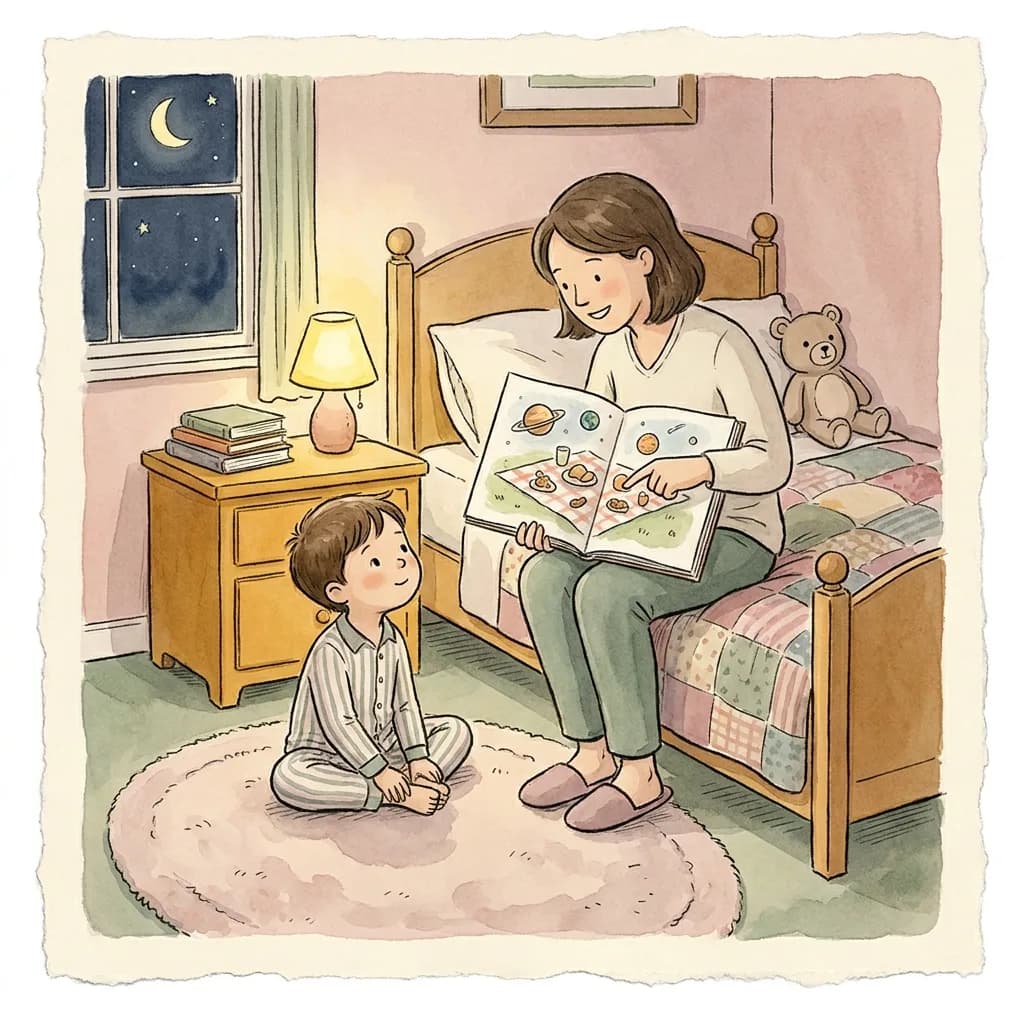
Stories for Preschoolers to Read: Picks by Mood and Length
The best stories for preschoolers are easy to follow, fun to repeat, and matched to the moment. Here is what to read aloud for calm, curiosity, big feelings, and bedtime.
The Short Answer
Good stories for preschoolers have one clear problem, a small cast, and an ending they can see coming. The best choice changes with the moment. A busy afternoon can hold a funny or curious story. Bedtime needs a slower one with less noise and a settled ending.
For a three- to five-year-old, start with five to ten minutes. Pick a story with a feeling or idea your child already knows, then read it again when they ask. Preschoolers do not need a new story every night. They get more out of a familiar one than adults tend to expect.
What Preschoolers Can Follow
Preschool covers a wide stretch. A three-year-old may track one character and one problem. A five-year-old can usually hold a longer sequence, more dialogue, and a second character's point of view. Four sits in the middle.
The CDC lists saying words from a familiar story and telling what comes next in a well-known story among common four-year milestones CDC, Milestones in Action by 4 Years. That is a useful test for choosing a read-aloud. The sequence should be clear enough to remember, and the language should leave a few lines your child can join.
What usually works:
- One or two main characters
- A problem a child can name
- A repeated phrase or pattern
- A setting they can picture
- A clear before and after
- A finished ending
For a closer age match, our guide to bedtime stories for 4 year olds covers plot, fears, and story length at the center of the preschool years.
Pick the Story by Mood
The easiest way to choose a preschool story is to start with the child in front of you. Match the story to the mood, not to a list of books somebody else called essential.
For calm after a noisy day, choose a small problem and a quiet solution. Taylor's Quiet Shell follows a turtle who learns how to step away from too much noise. Luma the Little Cloud handles loneliness and belonging without a villain or a chase.
For curiosity, use a story that asks one good question without turning into a lesson. Planet Picnic lets a child compare big and small from different points of view, then brings everyone back to the same picnic blanket.
For big feelings or friendship, pick a character whose mood changes for a reason your child can see. Mood Balloon Parade turns a heavy feeling into something visible, then lets friendship shift it a little at a time.
For confidence, a story about practice or trying again works better than a character who is simply declared brave. Rainbow Feathers and Pia and the Slushy Hill both keep the problem ordinary and give the child a way through it.
How Long Should a Preschool Story Be?
Use these as starting points, not rules:
- Age 3: about 5 to 7 minutes
- Age 4: about 6 to 10 minutes
- Age 5: about 8 to 12 minutes
Length matters less than the story's shape. If your child loses the thread, the story is too long for that night. If they can predict the ending and still want to hear it, the length is working.
A short story is not a lesser story. It gives a preschooler enough room to remember the sequence and join the repeated parts. Our guide to short bedtime stories goes deeper on length by age, and the short bedtime stories collection keeps the quickest listens together.
Read Aloud Without Turning It Into a Quiz
The American Academy of Pediatrics recommends engaging, interactive reading and books that fit a child's development, language, and culture AAP literacy policy statement. Interactive does not mean stopping on every page for a test. It means leaving room for the child to take a turn.
Try one or two of these during a read-aloud:
- Pause before a repeated line
- Ask what the character might do next
- Name one detail in the picture
- Let your child supply a sound
- Connect one moment to their day
- Accept a strange answer and keep reading
A study of three- and four-year-olds compared one reading with repeated readings and repeated readings that included questions. Hearing the story more than once helped children learn new words, while questions were especially helpful for saying those words aloud Senechal, Journal of Child Language. A few real pauses work. A running comprehension check does not.
Why the Same Story Keeps Working
Preschoolers ask for the same story because repetition changes their job. On the first read, they are finding the characters. On the next one, they notice the pattern. Soon they can predict a line, catch a missing detail, or tell part of it with you.
In a study of three-year-olds, children heard the same new words the same number of times. The group that heard them inside the same story repeatedly remembered the words better than the group that heard them across different stories Horst et al., Frontiers in Psychology.
So keep a small rotation. Three dependable stories are enough for a week. Change the voice, let your child finish one sentence, or ask them to choose the character you follow. The book can stay the same while the reading changes.
Where Audio Stories Fit
A live read-aloud is the best choice when you have the time and attention for it. Audio is useful when the alternative is a screen, a skipped story, or a parent forcing energy they do not have. The AAP advises keeping a caregiver's back-and-forth around audio and digital stories when possible, because the conversation is part of the value AAP literacy policy statement.
The full Gushi story library lets you choose by feeling and theme. You can start with the free bedtime stories collection, then use the bedtime stories app when you want a repeatable, screen-free last step before sleep.
Put the audio in the same place as a book: after pajamas and teeth, before the final goodnight. The broader toddler bedtime routine guide covers the rest of that sequence, while infant bedtime stories covers the stage before a child is ready to follow a real plot.
The Tonight Version
Choose one mood: calm, curious, feelings, or confidence. Pick a story with one small problem and a clear ending. Keep it under ten minutes, pause once for your child to join, and stop when the story ends.
If they ask for the same story tomorrow, use it again. Familiar is not boring to a preschooler. Familiar is where they start to own the story.
