
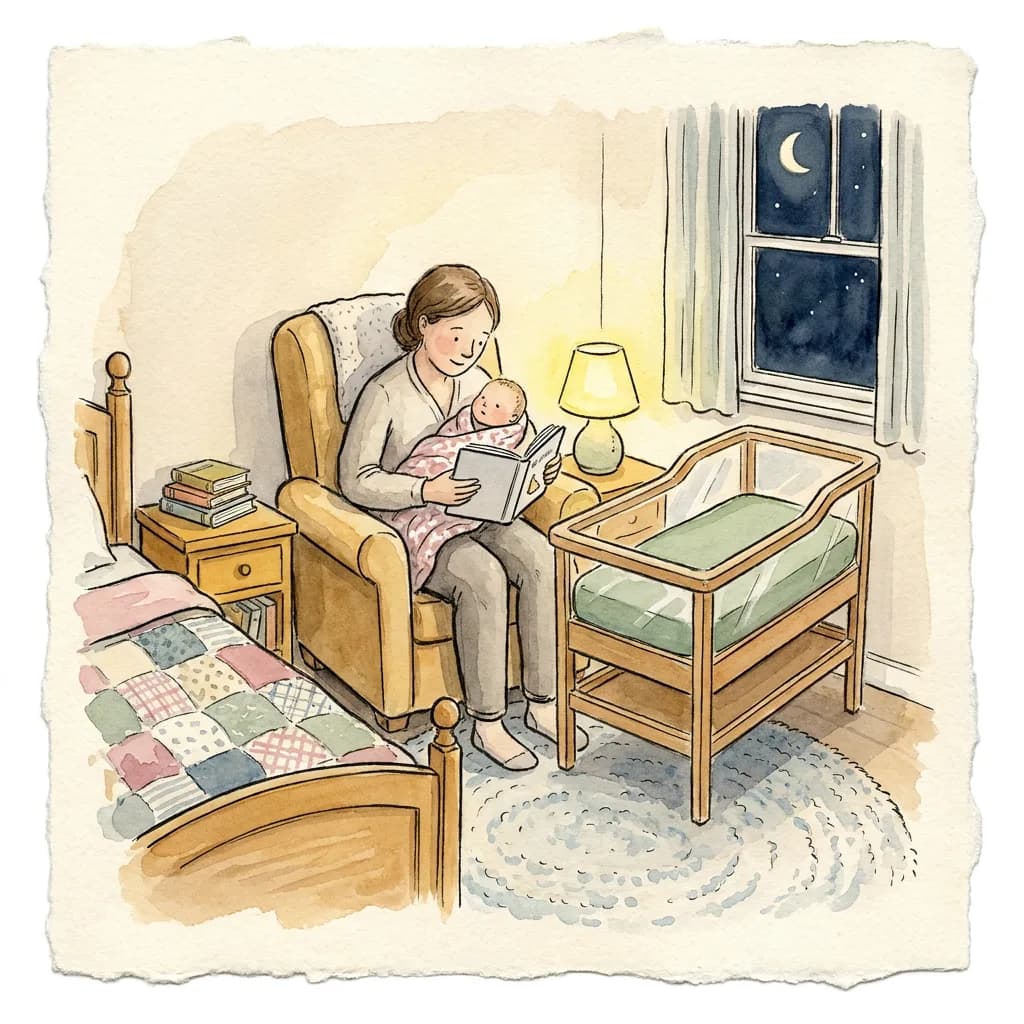
Infant Bedtime Stories: What to Read to Babies and Newborns
Infant bedtime stories are not about plot yet. They are about your voice, a calm routine, and a safe handoff to sleep. Here's what works from newborn through the first year.
The Short Answer
Infant bedtime stories should be short, soft, and mostly built around your voice. A newborn does not need a plot. A six-month-old does not need a twist. A baby needs rhythm, closeness, and the same calm sequence before sleep.
For most babies, the story can be one board book, one lullaby-like paragraph, or two minutes of naming what you see on the page. The American Academy of Pediatrics recommends shared reading from birth through at least kindergarten, including in the NICU when possible, because the point is the relationship as much as the words AAP HealthyChildren.
The safety rule matters more than the story choice: read or listen while your baby is awake and held, then put the baby down on their back in a clear sleep space. No books, blankets, pillows, stuffed toys, or story props stay in the crib.
Newborn Bedtime Stories: What Counts in the First 3 Months
For a newborn, a bedtime story is not really a story yet. It is your face, your breath, and a voice that slows down at the same point every night.
That means the simplest possible material works:
- A black-and-white board book
- A single nursery rhyme
- The same two pages every night
- A soft description of the room
- A tiny made-up story about the moon
- Your baby's name repeated in a calm sentence
This is why infant bedtime stories feel odd to adults at first. You are used to story meaning plot. Your baby is using the story as sound, connection, and a sleep cue. That is enough.
The AAP's 2024 literacy guidance is clear that reading aloud with babies is a language-rich, relationship-building activity, not a performance. Print books are ideal when you have them, but the real ingredient is a responsive adult making the moment warm and predictable AAP Pediatrics policy statement.
Newborn to 3 Months
In the first three months, keep the bedtime story almost boring. That is the point. Your baby is still learning the difference between day and night, awake and sleepy, close and alone.
Try one of these:
- One high-contrast page while you hold them
- A quiet rhyme after feeding
- A slow description of pajamas and lights
- A repeated goodnight sentence to each family member
- A song spoken instead of sung if singing wakes them up
Do not worry about finishing the book. Do not worry about whether the story is educational. If the baby turns away, fusses, or starts to melt down, the story is over. A good infant bedtime story ends before the baby is fully upset.
At this age, the best story is the one you can repeat without thinking. The same words in the same order become useful because they give the night a shape.
4 to 6 Months
By four to six months, babies are more awake to faces, voices, sounds, and repeated patterns. The story can become a little more interactive, but still not complicated.
The CDC's six-month guidance tells parents to read to babies every day by looking at colorful pictures, talking about them, and responding when the baby babbles back CDC milestones by 6 months. That is the right model for bedtime too. Point, name, pause, let the baby make a sound, answer softly.
Good story shapes for this age:
- One animal sound repeated softly
- One bedtime object named on each page
- A book with faces
- A story where every page ends with the same phrase
- A calm call-and-response like "Where is the moon? There it is."
This is also the age where screens are tempting because the baby finally watches them. The same CDC page says screen time is not recommended for children younger than two, except video calling. A paper book or a voice in a dark room is the better bedtime input.
7 to 12 Months
Late in the first year, the story can start to feel more like a tiny ritual. Your baby may reach for the book, pat the page, laugh at the same sound, or look at you when you say their name.
CDC milestones around nine months include looking when called by name, reacting when a caregiver leaves, and smiling or laughing at peek-a-boo CDC milestones by 9 months. By one year, many babies wave bye-bye, call a parent by a special name, and pause briefly when they hear no CDC milestones by 1 year. That is the listening range. They can join a pattern, but they are not ready for a real narrative arc.
Useful story choices now:
- Lift-the-flap books before lights dim
- Very short animal stories
- Books with one repeated bedtime phrase
- Stories that name body parts or familiar people
- Soft picture books with no surprise ending
If your baby is crawling, pulling up, or fighting the last step into the crib, keep the story before the final sleep-space transfer. The book happens in arms or on your lap. The crib stays for sleep.
Where the Story Fits in the Routine
The story should sit near the end of the routine, after feeding if that is part of your night, after pajamas, before the final put-down. It should not be the thing that reopens the night.
A study of infants using objective sleep measurement found that a bedtime routine at least five nights a week, started no later than 9 PM, was linked with longer and less variable nighttime sleep Tsai et al., Journal of Advanced Nursing. A larger international study of children from birth through age five found a dose-dependent relationship too: more consistent routines were associated with earlier bedtimes, shorter sleep onset, fewer night wakings, and longer sleep Mindell et al., Sleep.
That does not mean the story has to be elaborate. It means the story has to be repeatable. A two-minute story you can do every night beats a perfect routine that collapses by Wednesday.
If you are building the rest of the sequence around the story, our toddler bedtime routine guide covers the same structure once your baby becomes a toddler. For the broader story question across ages, start with bedtime stories for kids.
Safe Sleep Comes First
Infant bedtime stories should never add objects to the sleep space. The story is for the routine. The crib is for sleep.
CDC safe-sleep guidance, aligned with the AAP, says babies should sleep on their backs on a firm, flat surface, ideally in the caregiver's room for at least the first six months, with soft bedding kept out of the sleep area. That includes blankets, pillows, bumper pads, and soft toys CDC safe sleep. The AAP says the same: use a crib, bassinet, or portable play yard with a firm, flat mattress and fitted sheet, and keep loose blankets, pillows, stuffed toys, bumpers, and soft items out AAP Safe Sleep.
So the cozy-looking version is not the safe version. No plush character from the story. No loose blanket because the story mentioned one. No board book left beside the baby. Read, cuddle, finish, then clear sleep space.
When Audio Stories Start to Fit
For newborns and young infants, a caregiver's live voice is the strongest version of the bedtime story. You can pause, respond, and stop when the baby is done.
Audio becomes more useful as your child gets older and the routine needs a screen-free story that still lands on tired nights. That is where a short, calm library helps. Our story library is built for listening in the dark, with filtered collections for free bedtime stories and short bedtime stories. The bedtime stories app keeps the screen out of the routine once your child is ready for a fuller story.
For a first example of the tone, Luma the Little Cloud is the kind of soft, low-stakes story that works when a child is past the newborn stage and ready to listen to a little character with a little feeling.
The Tonight Version
If you have a newborn, pick one page, one rhyme, or one sentence you can repeat every night. Hold the baby. Read slowly. Stop before the baby is upset. Put the baby down on their back in a clear sleep space.
If you have an older baby, use the same pattern but add one small interaction: point to the moon, name the dog, pause for a babble, then answer it. Keep the story short enough that the routine still ends.
Infant bedtime stories work because they are small. A calm voice, a familiar rhythm, a safe crib, the same ending every night. That is the whole job.
