
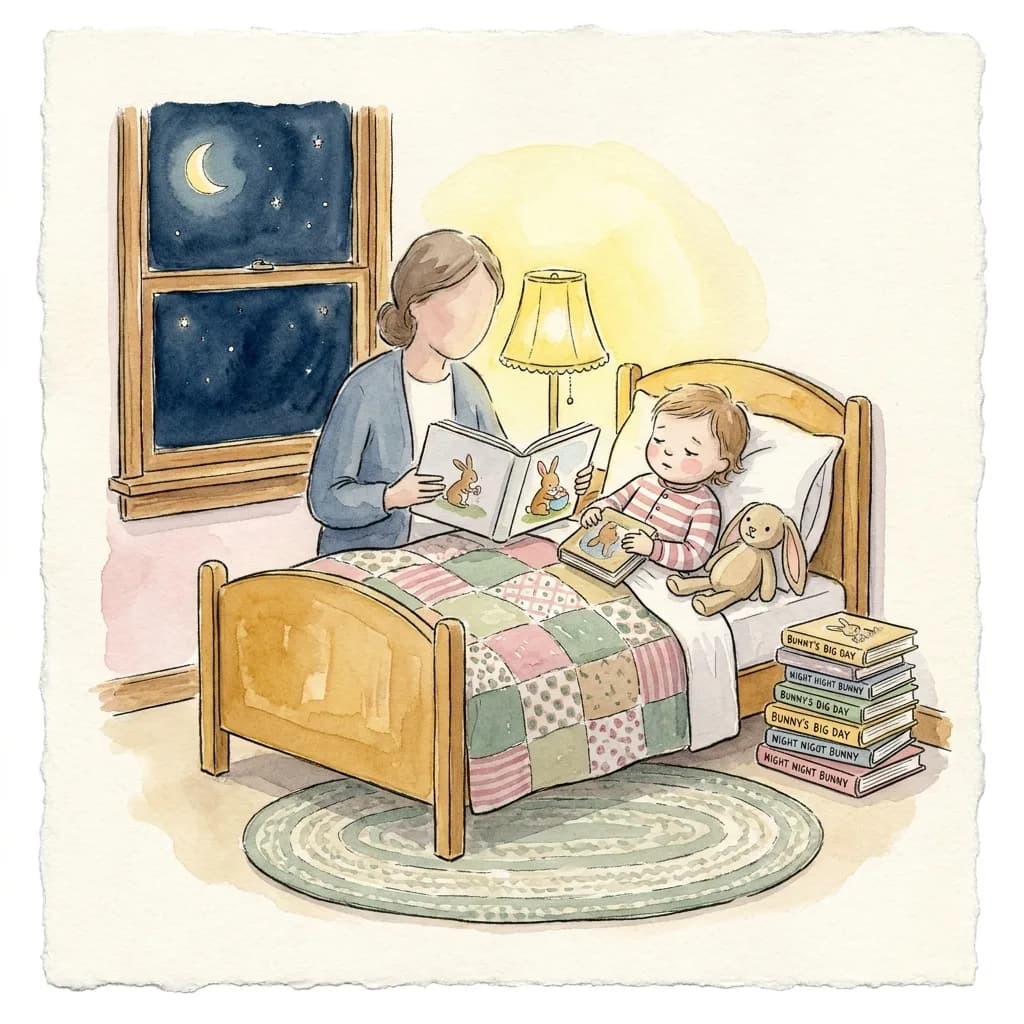
Bedtime Stories for 2 Year Olds: What Works at This Age and What to Skip
Two-year-olds want the same story over and over, and that's exactly the point. Here's what kind of bedtime story actually lands at two, how long it should be, and why repetition is doing more work than you think.
Two Is When the Story Is Mostly You
At two, a bedtime story is barely about plot. It's about your voice, the closeness, and the same words in the same order every night. Your kid doesn't need a hero arc. They need to know what comes next.
Two-year-olds are still building the equipment for a real story. The CDC's 24-month milestones expect most kids to put two words together ("more milk," "daddy go") and to point to things in a book when asked CDC, Milestones by 2 Years. That's the working range. Following a multi-character plot with a real twist isn't on the list yet, and a bedtime story written for that level will just slide off. The story that lands at two is small, slow, and repeats.
What a 2-Year-Old Can Actually Follow
Most two-year-olds can stay with a story that has one familiar character, one tiny event, and a phrase they've heard before. The shape matters more than the content. They're listening for the pattern, not the surprise.
What works at this age:
- One main character your child already knows by name
- A familiar setting like a bedroom or a small backyard
- A repeated phrase your kid can say along with you
- Big simple feelings like sleepy or hungry or happy
- Soft sensory detail like a warm blanket or a slow rain
- A soft settled ending that lands on a quiet moment
What to skip at bedtime, no matter how cute the book looks at the store:
- Chase scenes or any character that's loud the whole way through
- Sudden sound effects designed to make them laugh
- More than two named characters
- A surprise twist meant to land at the end
- A cliffhanger or to-be-continued ending
Two-year-olds will pick the same book every night for a month. That's not a phase to break. It's how they learn at this age, and at bedtime it's doing a second job: knowing what comes next is the part that settles them.
How Long a Bedtime Story Should Be at Two
Most two-year-olds settle well with a story in the two-to-four-minute range. Long enough to feel like a real story, short enough to finish before they wriggle off your lap or start lobbying for one more.
There's no perfect number. Some nights your kid will sit for five minutes without blinking. Some nights ninety seconds is the ceiling. A useful test: if they can hand you the book again the next morning and point to the character by name, the length was right. If they checked out halfway through, it ran long.
Two-year-olds also can't hold the long version yet. Pediatric estimates of focused attention put a two-year-old in the four-to-six-minute range for any single activity, and bedtime, when they're already tired, is the low end of that window Gaertner et al., focused attention in toddlers. Our deeper guide to short bedtime stories covers length ranges by age and why short almost always wins at bedtime. The cornerstone post on bedtime stories for kids walks through the case across ages one to eight, and the sibling guide on bedtime stories for 3 year olds picks up the next age window when a plot can start to land. Our own short bedtime stories collection is filtered to the lengths that fit this window.
Repetition Is the Whole Point
Parents worry about the same-book-again-tonight problem. That worry is misplaced. The same story, same words, same voice is doing more for a two-year-old than a new story would.
A study by Jessica Horst and colleagues found that young children who heard the same story three times in a week learned new words from it about 150 percent better than children who heard three different stories with the same target words mixed in Horst et al., Frontiers in Psychology. The kids hearing varied stories barely retained the new words at all. The kids hearing the same story over and over locked them in.
It's the same reason your two-year-old finishes your sentences when you read a familiar book. Knowing what's coming is the work. Each repeat is one more pass at the words, the shape, the rhythm of the sentence. By the time you've read it twenty times, they're not bored. They're using it to predict the world.
Miko's Little Hops from our library is the shape we mean: one rabbit, one feeling, the same little hop again and again until the story settles. No villain, no chase, no surprise. The repetition is the comfort, and at two it's also the lesson.
Stories Are Quietly Building Their Language
Two is the year language starts moving fast. A vocabulary that doubles or triples in a few months, the first real two-word sentences, the start of being able to ask for things by name. Bedtime stories feed that directly.
A longitudinal study of more than four thousand families found that preschoolers with regular language-based bedtime routines (reading, storytelling, singing) slept about ten minutes longer per night and scored roughly two points higher on a standardized vocabulary test at age five Hale et al., Journal of Family Psychology. Two points sounds small. Spread across every night for three years before kindergarten, it isn't.
The American Academy of Pediatrics updated its literacy promotion policy in 2024 to recommend shared reading from birth onward as a routine part of pediatric care, calling it one of the most evidence-backed early-development interventions a caregiver can do AAP, Pediatrics 2024. The AAP's HealthyChildren writeup is unusually direct: shared reading at this age strengthens attachment, brain circuitry, and language, in that order. A two-year-old sitting on your lap hearing the same book again is doing all three at once.
Audio Stories on the Tired Nights
A parent reading aloud from a board book is the gold standard at this age. On the nights you don't have it in you, audio stories hold the same slot in the routine without the screen.
The screen part matters more than it seems. A 2022 study of preschool-aged children found that one hour of ordinary evening room light suppressed melatonin by an average of around 85 percent, and most kids' melatonin stayed below baseline for nearly an hour after the light went off Hartstein et al., Journal of Pineal Research. A tablet held close to the face is far brighter than that. An audio story plays in the dark.
Audio also suits how a two-year-old listens. With no screen, the focus is on the voice and the rhythm, which is what's settling them anyway. The story is the length it is. No flipping back to a favorite page mid-bedtime, no "one more," no negotiation. It ends, and the room stays quiet. If your kid likes a small light on while they listen, the right kind matters more than the brand: our guide to night light for a toddler covers color and brightness. Our bedtime stories app is built for exactly this kind of night, and the full story library is sorted by theme so a tired parent isn't scrolling at 7:45.
The Story Is the Anchor of the Routine
The single most reliable thing you can do for a two-year-old's sleep is a short, predictable bedtime routine, done the same way every night. The story is usually its anchor.
Jodi Mindell's international study of more than ten thousand families is unusually clear on the youngest end. In the zero-to-three-year-old group, only 23 percent of kids whose families ran a nightly bedtime routine had parent-reported sleep problems, compared to 47 percent of kids whose families never ran one Mindell et al., Sleep 2015. That's a 24-percentage-point gap, and the effect was dose-dependent: more nights of the routine, fewer problems, in a smooth line.
That's the case for keeping the story consistent. Same spot in the sequence, after teeth and pajamas, right before the lights go down. Reading the book yourself and pressing play on an audio story both count. Same story two nights in a row counts. The Bedtime Routine Race, two little calves running a quiet race through their own bedtime, is the kind of audio story that doubles as a scaffold for the routine itself.
Our walk-through of a 2 year old bedtime covers what the rest of the sequence around the story should look like (the schedule, the nap question, the stalling), and our guide to a toddler bedtime routine covers what to keep and what to drop as your kid grows. The whole structure recommends the AASM's 11-to-14-hours-per-24 sleep target for ages one to two AASM Child Sleep Duration Health Advisory. Almost all of that has to come from the bedtime block, since the daytime nap is on its way out for a lot of two-year-olds.
The Tonight Version
If you want to try this without overhauling anything: tonight, pick one short calm story (the length of a song or two), the same one they liked last week. If you don't have a favorite yet, the free bedtime stories in our library are a fine place to start. Read it or play it after teeth and pajamas, in the dark, in the same spot every night. Don't add a second one when they ask.
Give it a week of the same story. Most two-year-olds settle into the new ending faster than parents expect, partly because a finished story is nothing to argue with. It starts, it ends, the lights stay off. The story does the work. The routine holds the night.
