
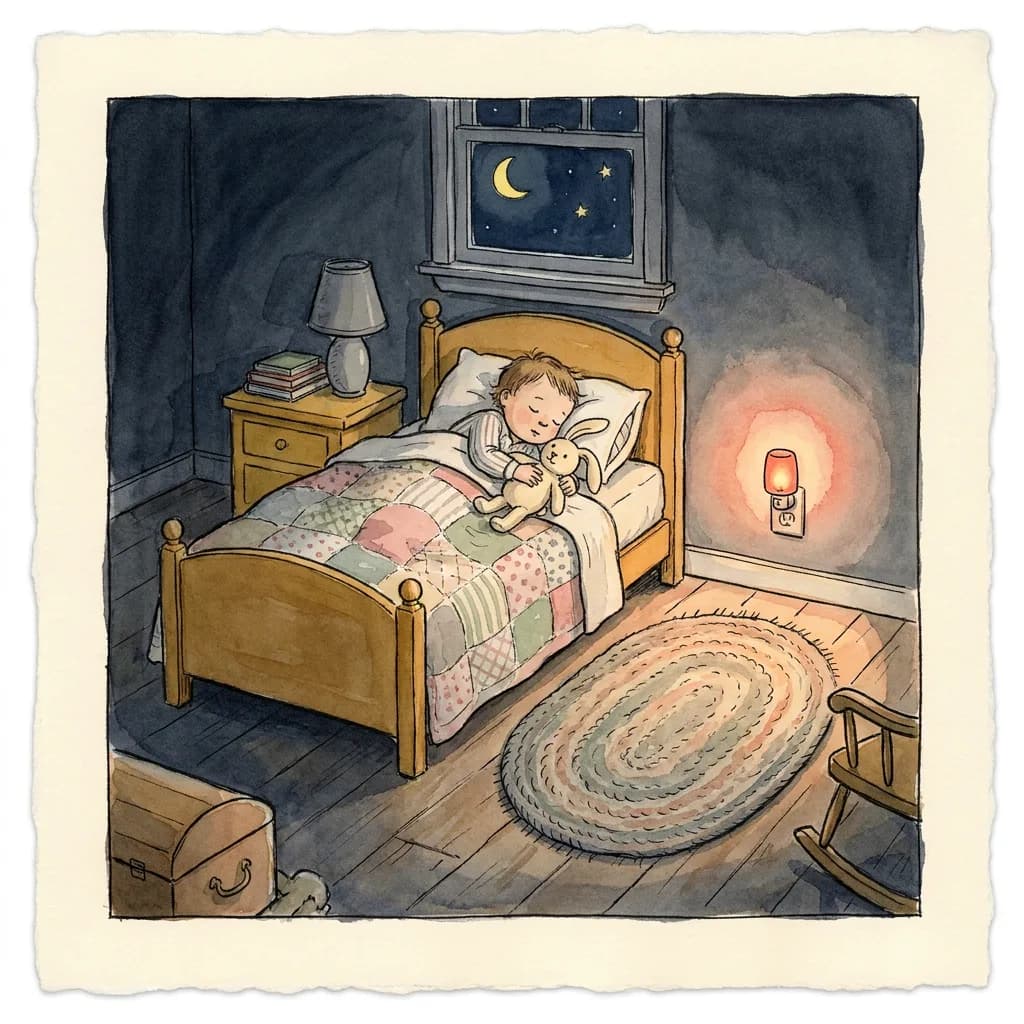
Night Light for Toddler: When It Helps, When It Hurts, and What Color to Pick
A dim night light can settle a scared toddler. The wrong one quietly tanks their sleep. Here's what the research actually says about light at night for young kids, and how to pick (and eventually retire) the one in their room.
The Aisle Is Lying to You
Walk down the baby aisle and the night lights look like decor. Glowing turtles. Color-shifting unicorns. A projector that paints stars on the ceiling. None of it is designed around what actually happens to a toddler's brain when light hits their eyes at bedtime.
A night light isn't neutral. It's a small intervention in a system that runs on darkness. Done right, it can take the edge off a fear that's keeping your kid up. Done wrong, it shaves real time off their sleep, every night, for as long as it's plugged in. This post walks through which one yours is.
What Light Actually Does to a Toddler at Night
Preschoolers are not small adults. Their eyes are clearer, their pupils larger, and their melatonin response to evening light is stronger than yours.
A 2022 University of Colorado study put numbers on it. Thirty-six children ages 3 to 5 got one hour of light exposure in the hour before their habitual bedtime, at intensities ranging from 5 to 5,000 lux. The average melatonin suppression across the full range was 85.4% Hartstein et al., J Pineal Research, 2022. Not the brightest condition. The average. And here's the part that matters for night lights: the lowest light level tested, 5 to 40 lux (dimmer than a typical room lamp), still produced 77.5% suppression. Sixty-two percent of the kids still had melatonin below half their baseline 50 minutes after the lights went out.
There is no quiet floor where a little bit of light is fine for a toddler's biology. The system reacts strongly to whatever's there. A bright bedside lamp and a dim plug-in night light land closer together on melatonin than they look like they should.
That doesn't mean every night light is a problem. It means the math is unforgiving, and the choices that matter are color, brightness, and placement.
Blue Light Is the Real Problem
Not all light suppresses melatonin equally. The blue end of the spectrum (which most LEDs, screens, and cool-white bulbs sit on) hits the circadian system hardest.
A study comparing children's melatonin response to blue-enriched white light (6200K) against warmer light (3000K) found that children showed about 81% suppression under the cool light, versus 58% under the warm one. The blue-enriched condition produced melatonin suppression roughly 2.7 times greater in children than in adults at the same exposure Lee et al., Physiological Reports, 2018. The authors concluded that low color temperature light is what to use at night for kids.
What this means in the night light aisle: a cool-white or color-cycling LED that glows blue, green, or cyan is the worst case. Red and amber, at the long end of the visible spectrum, do the least damage to melatonin and the circadian rhythm. If you're choosing one product over another, color temperature is the most important spec, and most night light packaging doesn't bother to list it.
When a Night Light Actually Helps
Most toddlers don't need a night light. The ones who do are usually working through a developmental window, not a sleep problem.
Around 2 to 3 years old, imagination comes online. The same brain that learned this week to pretend a banana is a phone is now imagining a thing in the closet. Fear of the dark is one of the most common preschool fears, and it tends to peak between ages 3 and 6 before fading on its own as kids learn to separate fantasy from reality. The AAP notes that nightmares can start as early as 6 months and tend to peak between 3 and 12 years AAP - HealthyChildren.org.
If a fear is what's keeping your kid up, a dim night light is a reasonable tool. The AAP's own guidance on nightmares is direct: "Allow them to keep a light on if it makes them feel better" AAP - HealthyChildren.org.
What a night light is not the right tool for:
- A general sleep upgrade for a kid who's sleeping fine in the dark
- A workaround for a bedtime routine that's falling apart (the routine is what's broken; fix the routine)
- A way to keep yourself oriented during night checks (use a phone with a covered screen instead
- then leave)
- Replacing the warmth or comfort of a parent at bedtime
If your toddler is in the middle of a rough developmental stretch and a fear is part of it, our walkthrough of the 2 year sleep regression covers the broader picture of why imagination, separation anxiety, and bedtime fights tend to land together in this window.
Picking the Right One
Three specs matter. Color, brightness, and placement. Cost and aesthetics don't.
Color: red or amber. The longer wavelengths have the smallest measurable effect on melatonin. Avoid anything that pulses, color-cycles, or has a blue, green, or cool-white default. If a night light has a color-changing mode, lock it on the warmest setting and don't let your kid touch the remote.
Brightness: the dimmest one that gets the job done. If you can read by it, it's too bright. A reasonable test is whether you can barely make out your toddler's face from across the room with the night light on and the door shut. Most plug-in night lights are sold at brightness levels well above that. Pick the dimmest one in the store, or one with a dimmer.
Placement: as far from the bed as the room allows, and pointing away from your kid's eyes. The ideal spot is near the floor, in the half of the room opposite the bed. Even better: in the hallway, with the bedroom door cracked. That gives a kid a visible "the world is still here" signal without putting the light source in their line of sight.
A few mechanical things to check before buying:
- The bulb stays cool to the touch (plug-in night lights with hot LEDs are a burn and fire risk over years of use)
- It's positioned where a climbing toddler can't pull it down or unplug it as a stalling tactic
- It does not double as a sound machine
- projector
- or screen (one job
- no animation
- no engagement; for the audio side of the room
- our white noise for sleep walkthrough covers volume and placement)
- It either has no off-timer or has one that turns it off entirely partway through the night rather than dimming and brightening on a cycle
The projector starscape category is the trap most parents fall into. It looks magical, it costs more, and it's the kind of engaging object that keeps a kid awake. If your toddler is the type who narrates the stars on the ceiling for forty minutes, the night light is now part of the bedtime problem. Replace it with a plain dim red plug-in and bedtime usually gets shorter.
Where to Put It
Placement is the spec parents get most wrong, and it costs more sleep than picking the wrong color.
A night light on the wall right next to the crib or bed, pointed up, puts a low-grade glow into your kid's eyes every time they roll over. A night light in a hallway, with the bedroom door cracked, casts a soft outline into the room but keeps the source out of view. The second option gives you most of the comfort benefit with a fraction of the melatonin cost.
For toddlers who need to see the room rather than just sense a glow, a single dim red light low on the wall on the side away from the bed works best. A floor-level source keeps the bulb out of your kid's line of sight when they're lying down. If you've already got a plug-in night light at outlet height across the room and bedtime is fine, leave it; it's a reasonable compromise.
If your toddler is also just leaving the crib, the bed transition is the bigger sleep variable. The crib-to-bed switch tends to surface fears and night wakings that were quiet before, and the night light decision often gets made in the middle of that adjustment. Pick the dim option then, not the brightest one in the store, even if the bedtime is rough for a week.
How to Wean Off It
Night lights work best as a temporary bridge. UCLA Health's pediatric sleep guidance puts it plainly: they're "not harmful for children" when used as a bridge, but if a kid never experiences darkness, they can't make the discovery that the room is just as safe without one UCLA Health. The goal isn't to use a night light forever. It's to use it long enough for the underlying fear to ease, then to step it down.
A weaning plan that tends to work for preschoolers:
- Move the light farther from the bed every couple of weeks until it's in the hallway
- Step the bulb down a level at each move (or use a dimmer switch)
- Let your kid lead on the next step. Ask if they want to try without it once a week. Some kids will say yes earlier than you expect
- Don't tie the night light to a reward chart or a deal. Make it a quiet
- low-stakes thing
- If a regression or a scary movie or a stretch of nightmares brings the night light back
- that's fine. The same wean works the second time
Most kids who started using a night light during a peak-imagination stretch around 3 or 4 don't need it by 6 or 7. If yours is still using one in elementary school and it's a small dim red plug-in, you have bigger things to worry about than that.
And if night lights aren't quite cutting it, the broader bedtime structure usually is what's actually missing. Our guide to building a toddler bedtime routine is the first piece to put in place: the routine carries far more weight than any single object in the room. For the audio step at the end of it, our bedtime stories app has multi-character narrated audio that plays in the dark, no screen — Keep Waddling models bravery for a toddler still working through fear of the dark.
The Boring Version of This Advice
Most toddlers sleep best in a dark room. If yours genuinely needs a night light because they're scared, pick one that is dim, red or amber, placed as far from the bed as the room allows (ideally in the hallway), and small enough not to draw attention as an object. Skip the projectors, the color cyclers, and anything you'd describe as cute. Plan to retire it as the fear eases, which usually happens within a year of when it started. Mindell's analysis of more than 10,000 families showed that the steady bedtime routine, not any single object, is what carries sleep at this age Mindell et al., Sleep, 2015. A night light is a small assist on the routine, not a replacement for it.
