
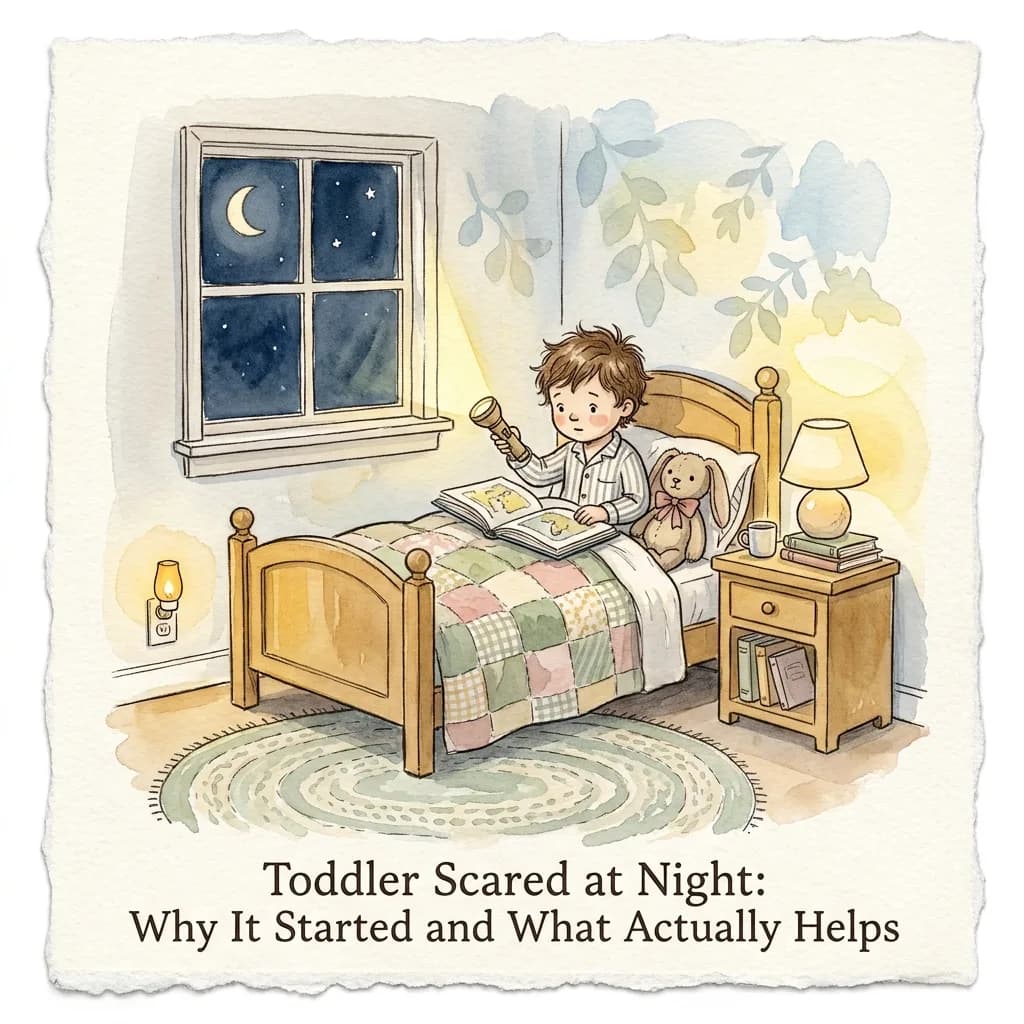
Toddler Scared at Night: Why It Started and What Actually Helps
A toddler who used to go down fine is suddenly scared at night. Here's why the fear arrived, how to tell it apart from a nightmare or night terror, and what to do that won't make bedtime worse.
The Fear Showed Up Out of Nowhere
For months your toddler went down fine. Then one week they started stalling at the door, asking you to stay, telling you there's something in the room. Bedtime got longer and the reason changed. It's not defiance anymore. They're scared.
This is one of the more unsettling shifts of the toddler years, because it looks like a step backward and it pulls hard on you as a parent. It usually isn't a step backward. A toddler getting scared at night is almost always a sign their brain is doing exactly what it's supposed to. The fear is new equipment, not a broken part. This post covers why it arrived, how to tell what kind of fear you're dealing with, and what to do that actually settles it instead of feeding it.
Why Two and Three Is When It Starts
Fear of the dark and nighttime fears tend to emerge somewhere around age two to three. It's not a coincidence that they show up alongside pretend play.
The same developmental leap that lets your toddler decide a banana is a phone also lets them imagine a thing behind the curtain. Imagination comes online before the ability to manage it does. A two- or three-year-old can generate a vivid mental image of a monster but cannot yet reliably tell you it isn't real. During the day that gap is delightful. At night, alone, in a dark room, it works against them.
Two other things stack on top of it in this window. Separation anxiety can resurge: the AAP describes a wave that fades around the second birthday but can return as a toddler's awareness sharpens AAP - HealthyChildren.org. And bedtime is the longest separation of the day, happening in the dark, right when the imagination is loudest. The fear isn't random. It's three normal developments landing in the same place at the same time. For the wider picture of why so much converges in this window, our walk-through of the 2 year sleep regression covers the same pattern, and by three the fears are often fully formed, which our 3 year old bedtime guide gets into.
Scared, Nightmare, or Night Terror?
"My toddler is scared at night" covers three different things, and they need three different responses. Sorting out which one you're seeing is the first useful step.
Bedtime fear is the awake kind. Your toddler is scared before they fall asleep: of the dark, of being alone, of the closet, of you leaving. They can tell you about it, and they're fully conscious. This is the one routine and reassurance work on.
A nightmare is a scary dream. The AAP notes nightmares can begin as early as 6 months and tend to peak between ages 3 and 12, usually in the second half of the night when dreaming is most intense AAP - HealthyChildren.org. A toddler wakes up genuinely frightened, can sometimes describe the dream, and wants comfort. Go in, reassure them they're safe, and help them settle back down.
A night terror is not a dream and not really being awake. The AAP describes night terrors as happening most often in toddlers and preschoolers, during deep sleep early in the night. A child may scream, thrash, sweat, and look terrified or glassy-eyed, and an episode can last up to 45 minutes AAP - HealthyChildren.org. The disorienting part: they won't remember it, because they were never actually awake. Waking a child during a night terror tends to make it worse. Keep them safe, stay calm, and wait it out. If you're not sure which of the three you're looking at, our deep-dive on night terrors vs nightmares walks through how to tell them apart in the moment, and our full guide to toddler night terrors covers what to do during an episode.
The rest of this post is about the first kind, the awake bedtime fear, because that's the one a parent can change with how they handle bedtime.
Take the Fear Seriously Without Confirming the Threat
The instinct most parents have is one of two extremes. Either reason the fear away ("there's no such thing as monsters, go to sleep") or fight the monster directly (the monster spray, the under-bed check, the closet sweep). Both tend to make it worse.
Reasoning doesn't work because the fear isn't a logic problem. Your toddler cannot yet separate imagined from real on demand, so a logical argument has nothing to land on. And monster spray, however well-meant, quietly confirms the premise: if we have to spray for monsters, monsters must be real. You've handed the fear a tool and an admission.
The middle path is to take the feeling completely seriously while staying calm and matter-of-fact about the room. "I know the dark feels scary right now. Your room is safe, and I'm close by." You're validating the emotion, which is real, without validating the threat, which isn't. Keep your tone boring. A toddler reads your face and voice for whether this is actually an emergency. Calm and unworried from you is itself a piece of information.
It also helps to know that toddlers underreport this to no one and overreport it to you at bedtime. One study of children's nighttime fears found that 73.3% of kids reported nighttime fears, and that parents markedly underestimated how frequent those fears actually were Muris et al., Behaviour Research and Therapy, 2001. If anything, the fear is more real to your child than it looks from the outside. That's a reason to take it seriously, not a reason to panic.
What Actually Helps at Bedtime
Once you've named the feeling, a few concrete things lower the fear without feeding it.
Keep the routine identical. A predictable wind-down, done the same way every night, is the single most protective thing you have. The predictability itself becomes the reassurance. If you don't have a steady one, our guide to building a toddler bedtime routine walks through what to keep and what to drop.
Practical adjustments that take the edge off:
- Offer a transitional object: a stuffed animal
- a small blanket
- or a t-shirt that smells like you
- Add a dim night light if your toddler asks for one
- kept red or amber and placed away from the bed; our deep-dive on the right night light for a toddler covers color and placement
- Leave the door open or cracked so the room doesn't feel sealed off
- Give a clear
- honest "I'll check on you in five minutes" and then actually do it
- so checking on them becomes something they can count on
- End the routine with something calm and external
- like a quiet story
- so the last thing in the room isn't their own imagination
That last point matters more than it sounds. A toddler lying alone in a dark, silent room has nothing to focus on but their own thoughts, and at this age the thoughts win. A calm voice or a gentle story gives the mind somewhere softer to land. Our bedtime stories app is built for exactly this — multi-character narrated audio in the dark, no screen — and Keep Waddling models doing the scary thing anyway while Taylor's Quiet Shell walks through a slow-breathing reset. It's also why, for a toddler who is mostly crying out of sadness or missing you rather than fear, the response shifts toward connection; our post on a toddler crying at bedtime covers that difference.
The Moves That Backfire
Almost everything that makes a nighttime fear stick around longer is something a tired parent does at 9 PM to end the night faster. Each move works once. The problem is the next night.
The patterns that quietly become permanent:
- Lying down with your toddler until they fall asleep
- every night
- Bringing them into your bed to cut the standoff short
- Sitting in the room for longer and longer stretches as the ask creeps up
- Letting the routine balloon from 30 minutes to 90 because each new request gets a yes
None of these are disasters in isolation, and a rough night or two of extra comfort won't ruin anything. The trouble is that a toddler updates their model of bedtime fast. Whatever got them to sleep last night is what they'll expect tonight, and the fear now has a condition attached: I can only sleep if you stay. You've made falling asleep depend on your presence, which means the fear has to be re-soothed every single night instead of slowly shrinking.
Worth a separate mention: scary or overstimulating screen content anywhere near bedtime. A toddler can't always tell you which show seeded the closet monster, but the image bank their imagination draws from is fed during the day. Keep the hour before bed calm and screen-light. The same goes for treating the fear as resistance and getting firm with it; if bedtime has turned into a nightly standoff, our post on a toddler fighting bedtime covers why pushing harder usually backfires.
Build Bravery Instead of Avoidance
The long game with a nighttime fear isn't to eliminate the dark from your toddler's life. It's to help them discover, in small doses, that the dark is survivable. Fears shrink through gentle exposure, not avoidance, and the exposure works best as play rather than a test.
A small clinical trial of children ages 4 to 8 with fear of the dark used exactly this approach: short, playful practice with darkness, paired with a story whose character models being brave. Children in the treatment group went from taking about 23 minutes to fall asleep down to roughly 11, with measurable drops in fear of nighttime and imaginary things Orgilés et al., European Journal of Pediatrics, 2026. The mechanism isn't complicated. The child practices being in the dark while feeling safe, over and over, until their brain updates.
What this looks like at toddler scale, kept light and game-like:
- Play hide-and-seek or flashlight games in a dimly lit room during the day
- so darkness gets paired with fun
- Read stories with a character who is a little scared and then handles it
- so bravery has a model
- Give your toddler one small thing they control
- like a flashlight or a light switch they're in charge of
- Name and praise the brave thing specifically: "You stayed in your bed and used your flashlight
- that was brave"
The goal is for your toddler to collect evidence, on their own terms, that nothing happens in the dark. Avoidance never lets them collect that evidence. Gentle, repeated, low-stakes exposure does. Most kids who hit a fear-of-the-dark stretch around two or three are through the worst of it within a year, especially when bedtime stays steady and the fear is met with calm rather than alarm.
When to Talk to Your Pediatrician
Most nighttime fear at this age is developmental and eases on its own with a steady routine and a calm response. A few patterns are worth raising with your pediatrician:
- Intense fear that lasts well beyond a few weeks and starts affecting daytime mood or behavior
- Fear that has spread from bedtime into daytime separation
- eating
- or playing alone
- Loud snoring
- mouth breathing
- or pauses in breathing during sleep
- Night terrors that are frequent
- escalating
- or causing injury
- Distress severe enough that your toddler can't function on a normal day
For context, the same nighttime-fears research found that roughly 10% of children had fears alongside a diagnosable anxiety disorder Muris et al., Behaviour Research and Therapy, 2001. Most toddlers are not in that group, and a pediatrician can help you tell the difference. Asking is not an overreaction; it's just calibration.
The Short Version
Your toddler being scared at night is normal, it arrived because their imagination grew faster than their ability to manage it, and it will ease. Figure out whether you're dealing with awake bedtime fear, a nightmare, or a night terror, because each needs a different response. Take the feeling seriously without confirming the threat, so skip the monster spray. Hold the routine, add small reasonable comforts like a dim night light or a lovey, and don't build in props you can't keep, like sleeping in their room every night. Help them practice being brave in the dark through play, in small doses, so they collect their own evidence that nothing happens. Stay calm, because your calm is the loudest signal in the room. It passes, usually within a year of when it started.
