
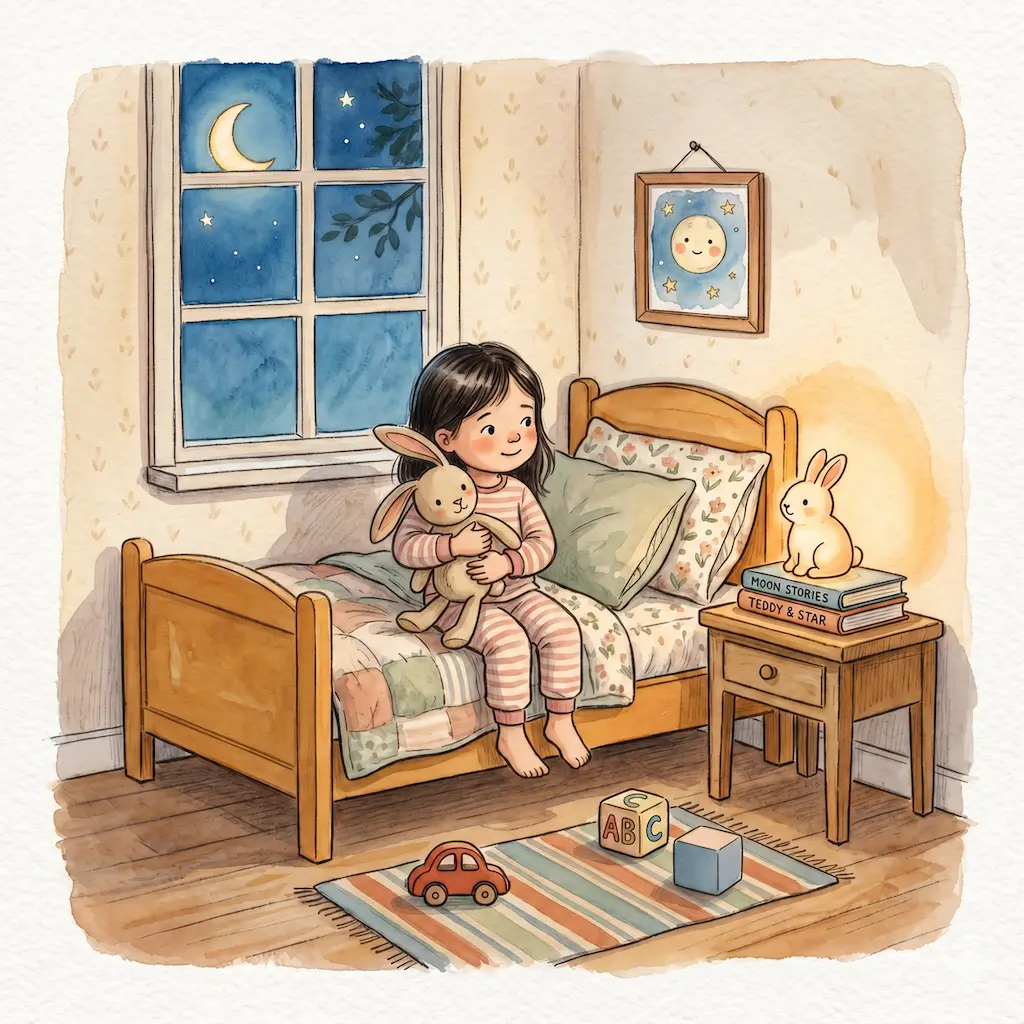
3 Year Old Bedtime: Why It Got Harder and What Actually Helps
Three-year-olds bring vocabulary, imagination, and a lot of stalling to bedtime. Here's how much sleep they actually need, why the routine matters more now than ever, and what's behind the new fears at night.
Three Brings New Material
Two-year-olds resist bedtime. Three-year-olds negotiate it. Something shifts around the third birthday. Your kid suddenly has the vocabulary to argue, the imagination to invent reasons not to sleep, and the confidence to test whether you actually meant what you said about lights out.
Most of what you're seeing is normal and developmental. At three, your child's vocabulary is climbing into the hundreds (sometimes thousands) of words, their memory is sharpening, and their imagination is running ahead of their ability to manage it. All of that growth has to land somewhere. Bedtime is where it usually shows up.
What Time Should a 3 Year Old Go to Bed?
Most three-year-olds do best with a bedtime between 7:00 and 8:30 PM. A bit earlier on days without a nap, a bit later on days with one.
The American Academy of Pediatrics endorses the American Academy of Sleep Medicine recommendation that children ages 3 to 5 sleep 10 to 13 hours per 24 hours, including naps AAP - HealthyChildren.org. So if your three-year-old is up at 7:00 AM and still naps for an hour or two, a 7:30 to 8:00 PM bedtime puts them in the right range. If the nap is gone, you'll usually need to pull bedtime earlier, closer to 7:00, to hit the same total.
The exact clock time matters less than consistency. Same wake-up. Same general window for bed. Bodies sync to that pattern faster than most parents expect.
The 3 Year Old Sleep Regression Is a Thing
Around age three, a lot of kids who were sleeping fine suddenly aren't. Bedtime turns into a fight again. They wake at 2 AM asking who's in the closet. The nap implodes.
This isn't a regression in the "going backward" sense. It's the visible side effect of a developmental burst. New language, sharper memory, bigger emotions, and a much louder imagination all arrive in a tight window, and sleep gets noisy while the brain reorganizes itself around the new equipment.
These episodes typically last 2 to 6 weeks. The most useful thing you can do during one is keep the routine identical. New props (a parent sleeping on the floor, sudden bottle revivals, hour-long bedtime extensions) are easy to introduce and very hard to undo. Ride it out with the routine you already have. For the full picture on what's developmentally behind it and what makes a rough stretch stick, our post on the 3 year sleep regression goes deeper, and the 2 year sleep regression walk-through covers the same pattern a year earlier.
The Nap Question
Somewhere between three and four, the nap usually starts to wobble. A longitudinal study of early nap cessation found that a substantial minority of three-year-olds have already given up the nap, while many others still need it well into age four Sleep Health, 2022. Both are normal.
Signs the nap is on its way out:
- Bedtime keeps drifting past 9:00 PM
- Nap time has turned into a 90-minute negotiation
- Wake-ups are creeping toward 5:30 AM
- No-nap days end fine with a normal mood at dinner
If you're not sure, swap the nap for quiet time in their room: books, soft toys, lights low. Some kids fall asleep anyway. Others rest for an hour and come out fine. Either is a win.
If you cut the nap, expect bedtime to move earlier by 30 to 60 minutes for a few weeks while their schedule recalibrates.
Where the Monsters Come From
Around three, fears start showing up at bedtime in a way they didn't before. The dark is suddenly a problem. Shadows mean something. There's a thing under the bed.
This isn't your child being dramatic. Nighttime fears are common in young children and tend to peak in the preschool years. A widely cited parent-child study of school-age kids found roughly 73 percent reported some kind of fear at night, with the dark and "scary creatures" near the top of the list Behaviour Research and Therapy, Muris et al.. The same imagination that lets your three-year-old play pretend during the day is now generating things they don't want to think about in the dark.
What helps:
- Take the fear seriously without confirming the threat (don't "spray for monsters")
- Add a low night light if they ask for one (our deep-dive on the right night light for a toddler covers color and placement)
- Keep the door open or cracked
- End the routine with something calm and external like a story
What doesn't help is reasoning them out of it. The fear isn't a logic problem. It's a developmental phase, and it eases as their ability to self-regulate catches up to their imagination. Our full guide to a toddler scared at night covers how to tell apart an awake fear from a nightmare or night terror, and what to do for each. The story slot at the end of the routine is also a quiet place to model bravery without lecturing — Keep Waddling is a short audio story about doing the scary thing anyway, narrated with multiple character voices in our bedtime stories app.
The Routine Still Beats Everything
The most effective tool you have at this age is the same one you had a year ago: a short, predictable bedtime routine done the same way every night.
Mindell's research across thousands of families found a dose-dependent relationship between routine consistency and sleep Sleep, 2015. The more nights per week a young child followed the same sequence, the earlier they fell asleep, the fewer night wakings they had, and the more total sleep they got. The effect held across countries and across age groups from infancy through preschool.
For three-year-olds, the routine that works tends to look like this:
- Screens off at least an hour before bed
- Bath or wash up
- Pajamas and teeth
- One book or one short bedtime story
- Lights out
Twenty to thirty minutes, in the same order, every night. If you don't have one yet, our guide to building a toddler bedtime routine walks through what to keep and what to drop, and our post on bedtime stories for 3 year olds covers what kind of story belongs in that story slot. If you want a ready-made one, Counting Clouds with Coco uses guided breathing inside the narrative and the rest of the library is filterable by theme.
The screens-off window matters more than parents tend to think. A 2022 study of children ages 3 to 4 found that even an hour of evening light exposure suppressed their melatonin by roughly 70 to 99 percent Hartstein et al., J Pineal Research, 2022. That's a biochemical reason a tablet right before bed makes everything harder, even if your kid seems calm while using it.
When to Pay Closer Attention
Most three-year-old bedtime difficulty resolves on its own once a steady routine is in place. A few patterns are worth bringing up with your pediatrician though:
- Loud snoring or mouth breathing every night
- Pauses in breathing during sleep
- Daytime sleepiness despite enough night sleep
- Severe anxiety that lasts beyond a few weeks and starts affecting daytime behavior
For everything else, the playbook is the same one that worked at two: hold the routine, name the feelings, keep your tone boring, let the boundary do the work. They're growing fast. Their sleep will catch up. If you're still in the thick of bedtime fights, our post on toddlers fighting bedtime covers what's actually going on and what to do about it.
