
3 Year Old Sleep Regression: What Helps at Three
Bedtime worked for months. Now your three-year-old is up at 2 AM, fighting lights out, and asking who's in the closet. Here's what's actually happening at three, how long it usually lasts, and what makes a rough stretch stick.
They Were Sleeping Fine
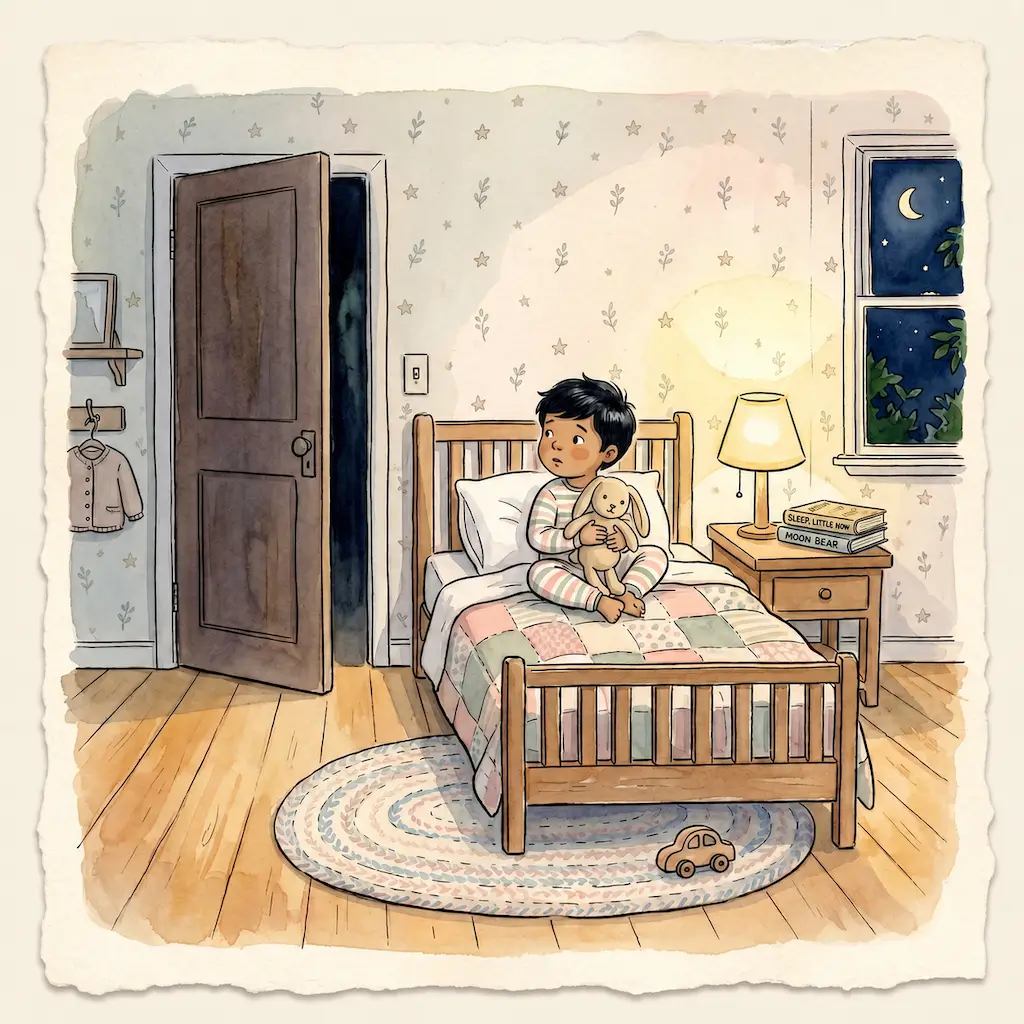
A month ago your kid was going down at 7:30 without much fuss. Then somewhere around the third birthday, the whole thing came apart. Bedtime turned into a 60-minute stall. They're up at 2 AM convinced something is in the closet. The nap, if you still had one, is gone or going.
You didn't change anything. They didn't change anything you can see. The 3 year sleep regression is the catch-all parents use for the stretch of bad sleep that hits a lot of three-year-olds in the months around their birthday. Whether that's the right name for it is another question.
Is the 3 Year Old Sleep Regression a Real Thing?
Short answer: kind of.
The phrase '3 year old sleep regression' shows up everywhere in parent-facing content and almost nowhere in the pediatric literature. Pediatric sleep researcher Jodi Mindell, looking across data from thousands of infants and toddlers, found 'no specific age at which all of a sudden you see a shift in sleep' Dr. Craig Canapari, MD. The neat calendar of regressions at 4, 8, 12, 18, 24, and 36 months that you see on parenting blogs isn't really backed by clinical evidence.
What is real: a lot of three-year-olds sleep badly for a few weeks at a time. Bedtime problems and night wakings show up in 15 to 30 percent of two- to five-year-olds across studies, and the prevalence climbs at three and four compared to earlier toddlerhood AASM Practice Parameters Review. One pediatric review found bedtime resistance in roughly 28 percent of preschoolers Turnbull, Reid & Morton, NIH-PMC. A great sleeper falling apart at three isn't a freak case. It's a category that hits a real slice of every cohort.
The useful framing: 'regression' is a parent word for a developmental window where a few things land at once and sleep takes the hit. Naming it doesn't fix it. Knowing what's behind it does. The same pattern recurs across the toddler years, and our umbrella on toddler sleep regression covers what's shared across the 18-month, 2-year, and 3-year windows.
What's Actually Happening at Three
Three is a building site. Several things tend to stack within a few months of each other, and any one of them is enough to wreck a bedtime routine.
Language has filled in. The CDC's developmental milestones expect a three-year-old to be holding a two-back-and-forth conversation, asking 'who,' 'what,' 'where,' and 'why' questions, and being understandable to people outside the family most of the time CDC, Learn the Signs. That's a kid with the vocabulary to negotiate bedtime in a way they couldn't six months ago.
Imagination is louder. The same brain that's now pretending a couch cushion is a boat is also generating ideas about what might be behind the curtain. Three is roughly when nighttime fears start showing up. The peak for frequent bad dreams in preschoolers lands at 41 months, where about 3.9 percent of kids have them often or always, in a longitudinal study of nearly a thousand Quebec children Simard et al., Sleep, NIH-PMC.
The nap is wobbling. A meta-analysis pooling pediatric nap data found that by age three about a third of kids have dropped the daytime nap entirely, while the rest still need it. By four, roughly 60 percent are done Staton et al., Sleep Med Rev, NIH-PMC. The transition is messy. A kid who isn't napping but still needs to nap will hit bedtime overtired and wired, which looks exactly like regression.
Potty training, if you're in it, is its own disruption. New body awareness wakes kids up, and the practice of getting out of bed for a legitimate reason quickly becomes the practice of getting out of bed.
Independence is the whole point of being three. Bedtime is the most obvious place that 'I do it myself' meets a wall, and your kid is testing where their control ends.
How Long Does the 3 Year Old Sleep Regression Last?
Most parents see the worst of it ease within 2 to 6 weeks, which is the timeline pediatric sleep practitioners cite for developmental sleep disruption at this age.
The risk is that it doesn't have to be that short. A longitudinal study following more than 350 children found that 21 to 35 percent of kids with sleep problems at one measurement point still had them at a later one, and kids with early sleep issues had three to five times the risk of ongoing sleep difficulties compared to kids without them Williamson et al., Pediatrics, NIH-PMC. The single biggest factor that turns a temporary stretch into a months-long pattern is what gets introduced to cope with it.
Where the Fears Are Coming From
If your three-year-old is suddenly scared of the dark, scared of being alone, or asking detailed questions about what's under the bed, that's on schedule. A study of preschool nighttime fears found that the kids with persistent fears were far less able to separate reality from fantasy than their peers Zisenwine et al., Child Psychiatry Hum Dev, 2012. The same imagination that powers pretend play during the day is the one generating things they don't want to think about in the dark.
Separation anxiety can also resurge here. The AAP describes a wave that starts in the second half of year one and usually fades by two, but it can come back as awareness sharpens around three AAP - HealthyChildren.org. A kid who was fine being put down at thirty months can suddenly need three goodbyes at thirty-six.
What helps:
- Take the fear seriously without confirming the threat (don't 'spray for monsters')
- Add a low night light if they ask for one
- Keep the door open or cracked
- End the routine with something calm and external like a story
What doesn't help is reasoning them out of it. The fear isn't a logic problem and they can't think their way past it yet. It's a phase, and it eases as their ability to self-regulate catches up to their imagination. For the story slot at the end of the routine, our bedtime stories app has multi-character narrated audio — Keep Waddling models doing the scary thing anyway and Taylor's Quiet Shell walks through a slow-breathing reset.
The Mistakes That Make It Stick
During a bad stretch, you'll do almost anything to get the kid down. Most of those moves are fine in isolation. The ones that cause trouble are the ones that quietly become permanent.
The pattern that traps parents:
- Lying down with them every night until they fall asleep
- Bringing them into your bed to end the wake-up faster
- Reviving a pacifier or bottle they'd already dropped
- Stretching the routine from 20 minutes to 60 because each new ask gets a yes
Each of those works in the moment. The problem is the next morning, when your kid has updated their model of how bedtime works. The new step is now part of the routine they expect. Whatever you added during the rough week is what you'll be undoing for the next two months.
The principle: don't introduce a sleep prop during a regression that you aren't prepared to keep. A night light or a comfort object is fine. Sleeping on their floor is a much harder undo.
What Actually Helps: Hold the Routine
The most boring advice is also the best-supported one. Keep the bedtime routine identical to what it was before everything fell apart.
Mindell's analysis of more than 10,000 families across 14 countries found a dose-dependent relationship between bedtime routine consistency and sleep Mindell et al., Sleep, 2015. The more nights per week a young child followed the same wind-down sequence, the earlier they fell asleep, the fewer times they woke at night, and the more total sleep they got. The effect held across countries and across ages from infancy through preschool. During a rough patch, that consistency is doing more work than anything else.
A routine that holds up at three looks like this:
- Screens off at least an hour before bed
- Bath or wash up
- Pajamas and teeth
- One book or audio story
- Lights out
Twenty to thirty minutes, same order, every night. If you don't have one yet, our guide to building a toddler bedtime routine walks through what to keep and what to drop.
A few mechanical adjustments pair well with holding the routine:
- Pull bedtime earlier by 15 to 30 minutes if your kid is overtired before the routine starts
- Tighten the nap window if there still is one. A nap that ends after 3 PM eats into bedtime
- Dim the lights as bedtime approaches: a 2022 study found that an hour of evening light exposure suppressed melatonin in three- and four-year-olds by an average of 85 percent <a href="https://pubmed.ncbi.nlm.nih.gov/34997782/">Hartstein et al.
- J Pineal Research
- 2022</a>
None of these need willpower from your kid. They lower the biological resistance to sleep before you get to the bedtime conversation. For more on what three actually looks like at lights out, our 3 year old bedtime guide covers the schedule side. If you're stuck in nightly fights, the post on toddlers fighting bedtime walks through what's behind them.
When It's Not a Regression
Some of what looks like a regression is something else. A few patterns are worth a closer look with your pediatrician AAP - HealthyChildren.org:
- Loud snoring or mouth breathing every night
- Visible pauses in breathing during sleep
- Wake-ups at the same exact time every night (more typical of an environmental trigger than a developmental one)
- Severe distress at bedtime that lasts beyond 6 weeks and starts affecting daytime mood
- Daytime sleepiness that doesn't improve when total sleep does
For everything else, the playbook hasn't moved. Hold the routine. Don't add anything you can't keep. Give it time. Most 3 year sleep regressions resolve on their own within a few weeks. The kids who come out of them sleeping well are the ones whose parents kept the bedtime they already had. The same pattern hits a year earlier too, and our walk-through of the 2 year sleep regression covers the developmental side and what makes a rough stretch stick.
