
4 Year Old Bedtime: What Helps at Lights Out
Four-year-olds know more, want more, and have more to say at bedtime than they did last year. Here's what's behind the curtain calls, the new fears, and the bedtime that suddenly takes an hour, with what actually helps.
Four Brings the Curtain Calls
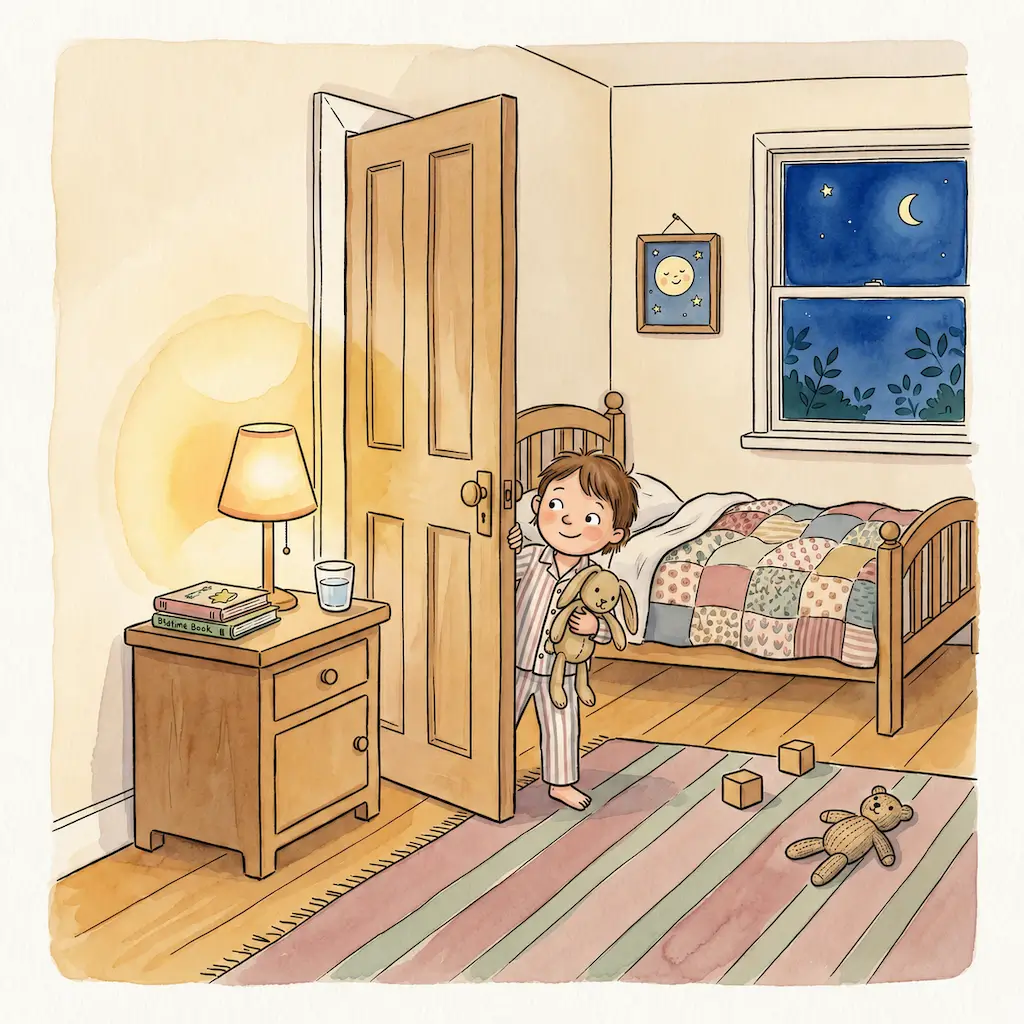
Three-year-olds negotiate bedtime. Four-year-olds put on a show. By four, your kid has the language to argue, the imagination to invent, and a brand-new ability to track what's happening on the other side of the bedroom door. Bedtime stops being a transition and becomes a production.
Most of what you're seeing is normal. Four sits in the middle of a major build phase for executive function and theory of mind, the cognitive systems that let your kid track other people's intentions and plan around them Marcovitch et al., NIH-PMC. The result is a child who can tell you exactly why one more story is fair, then come back two minutes later with a follow-up argument.
4 Year Old Bedtime: What to Expect at Lights Out
Four year old bedtime usually looks like a mix of stalling, opinions, and brand-new fears that weren't there six months ago. The kid is calmer than they were at three but louder about it — fewer meltdowns, more arguments. Most of the routine still works, but the last twenty minutes before lights out are the ones that need the most discipline.
If you want the short version: hold the routine, expect at least one curtain call a night, and don't let the bedtime drift past the window your kid's wake-up demands. The rest of this post is the why.
What Time Should a 4 Year Old Go to Bed?
Pediatricians don't endorse a specific bedtime clock time. They endorse a sleep total. The American Academy of Pediatrics endorses the American Academy of Sleep Medicine recommendation that children ages 3 to 5 sleep 10 to 13 hours per 24 hours, including any nap time AAP - HealthyChildren.org.
Work backward from when your kid wakes up. If wake-up is 7:00 AM and the nap is gone, a 7:00 to 8:30 PM bedtime lands in the right range. If your four-year-old still naps, you can push bedtime later, but the nap usually softens evening sleep pressure enough that bedtime takes longer no matter when you start.
Consistency beats precision. Same wake-up, same general bedtime window, every day, weekends included. Bodies sync to a pattern faster than they sync to a clock.
The Curtain Calls Are a Phase
At four, bedtime stalling stops looking like resistance and starts looking like creativity. One more drink. One more hug. The bathroom. A serious question about whether sharks sleep. None of it is random.
Bedtime resistance shows up in roughly 15 to 30 percent of preschoolers, and the prevalence runs higher at three and four than in toddlerhood AASM Practice Parameters Review. That tracks with what's developing cognitively. Theory of mind, your kid's growing ability to model what other people are thinking, hits a major window between three and five, and executive function jumps in the same period Marcovitch et al., NIH-PMC. Together, those skills make a kid who can imagine you giving in, plan a strategy to make it happen, and adjust mid-conversation when the first plan stops working.
The fix is closing the loop instead of fighting each request. Anticipate the asks and bake them into the routine. Drink before teeth. Last hug after lights are off. One question allowed. The rule is simple. Asks happen at these specific points, and then you're done. Predictability beats willpower at this age.
Bad Dreams Show Up Around Now
If your four-year-old has started waking up scared in the middle of the night, this is the age. Nightmares are most common in early childhood, with a peak between roughly three and six Petit et al., Sleep, NIH-PMC. Around the same window, sleep terrors, which are a different thing where the child screams and thrashes but isn't really awake, occur in roughly 1 to 6.5 percent of children, peaking between five and seven Leung et al., NIH-PMC.
The way to tell them apart: nightmares wake your kid up, and they can talk to you about it. Sleep terrors look more dramatic, but your kid is still asleep and won't remember it in the morning. Nightmares respond to comfort. Sleep terrors don't, and trying to wake your kid through one usually makes it worse.
Either way, the daytime fix is the same. Keep the wind-down calm and screen-free. Save anything high-energy or scary for earlier in the day. If a specific show or story keeps showing up in your kid's nightmares, drop it from rotation for a few weeks.
The Nap Is Probably Gone
By age four, most kids have stopped napping. A 2020 meta-analysis pooling pediatric nap data found that about 80 percent of children ages four to five no longer nap, and 94 percent are done by age five Staton et al., Sleep Med Rev, NIH-PMC.
Some four-year-olds still need one. Signs they do:
- Meltdowns at 5:00 PM
- Falling asleep in the car after preschool
- Mid-afternoon crashes that don't recover
- Bedtime is fine and wake-up is reasonable on nap days
Signs the nap is on its way out:
- Bedtime keeps drifting past 9:00 PM
- Naps turn into hour-long negotiations
- Wake-ups creep earlier
- Mood holds up fine on no-nap days
Quiet time is the in-between. Books, soft toys, low light, in their room for 45 minutes after lunch. Some kids fall asleep, some don't, both are fine. If you cut the nap entirely, expect bedtime to move 30 to 60 minutes earlier for a few weeks while their schedule recalibrates.
Screens, Light, and the Late Sunset Problem
Two things make four-year-old bedtime harder than adult bedtime, and both are biological.
First, preschoolers' eyes are more sensitive to light than adults' eyes are. A 2022 study of three- and four-year-olds found that one hour of evening light exposure suppressed melatonin by an average of 85 percent, with some kids hitting nearly 99 percent suppression Hartstein et al., J Pineal Research, 2022. That isn't a behavior problem. The light reaches the back of the eye, the brain delays the sleep signal, and bedtime slides later.
Second, bright evenings push it further. A field study of preschool-age children found that bedtime and evening light exposure together explained about half of the variance in when their bodies started releasing melatonin Akacem, Wright, & LeBourgeois, Sleep Health, 2016. Practically, that means summer bedtimes, late sunsets, and bright overhead lighting in the hour before bed all stack the deck against you.
What works: screens off at least an hour before bed, dim the lights as bedtime approaches, and pull blackout curtains on long-light evenings. None of these need willpower from your kid. They lower the biological resistance to sleep before you ever get to the bedtime conversation.
The Routine Still Beats Everything
At four, the most useful tool in your bedtime kit is the same one that worked at two. A short, predictable routine that runs the same way every night.
Mindell's analysis of more than 10,000 families across 14 countries found a dose-dependent relationship between routine consistency and sleep Mindell et al., Sleep, 2015. The more nights per week kids followed the same wind-down sequence, the earlier they fell asleep, the fewer times they woke at night, and the more total sleep they got. The effect held across cultures and across age groups from infancy through preschool.
For four-year-olds, the routine that works tends to look like this:
- Screens off at least an hour before bed
- Bath or wash up
- Pajamas and teeth
- One book or audio story
- Lights out
Twenty to thirty minutes total. Same sequence every night. If you don't have one yet, our guide to building a toddler bedtime routine walks through what to keep and what to drop, and our deeper pick on bedtime stories for 4 year olds covers what kind of story lands at this age and what to skip. For the audio story step, our bedtime stories app has a small library of multi-character narrated stories aimed at this age, like Echo Cave, which teaches kind words and self-talk through a glowing-cave adventure, and Rainbow Feathers, a gentle lesson on practice and patience.
When to Pay Closer Attention
Most four-year-old bedtime difficulty resolves once the routine settles. A few patterns are worth raising with your pediatrician though AAP - HealthyChildren.org:
- Loud snoring or mouth breathing every night
- Visible pauses in breathing during sleep
- Daytime sleepiness or attention problems even after a full night of sleep
- Severe bedtime anxiety that lasts more than a few weeks and starts affecting daytime behavior
For everything else, the playbook is the same one that worked at three. Hold the routine. Name the feelings. Keep your tone steady. Let the boundary do the work. The curtain calls don't last forever. By five, most kids are easier at bedtime than they were at four. If you're still in the thick of it, our post on toddlers fighting bedtime covers what's actually going on and what to do about it.
