
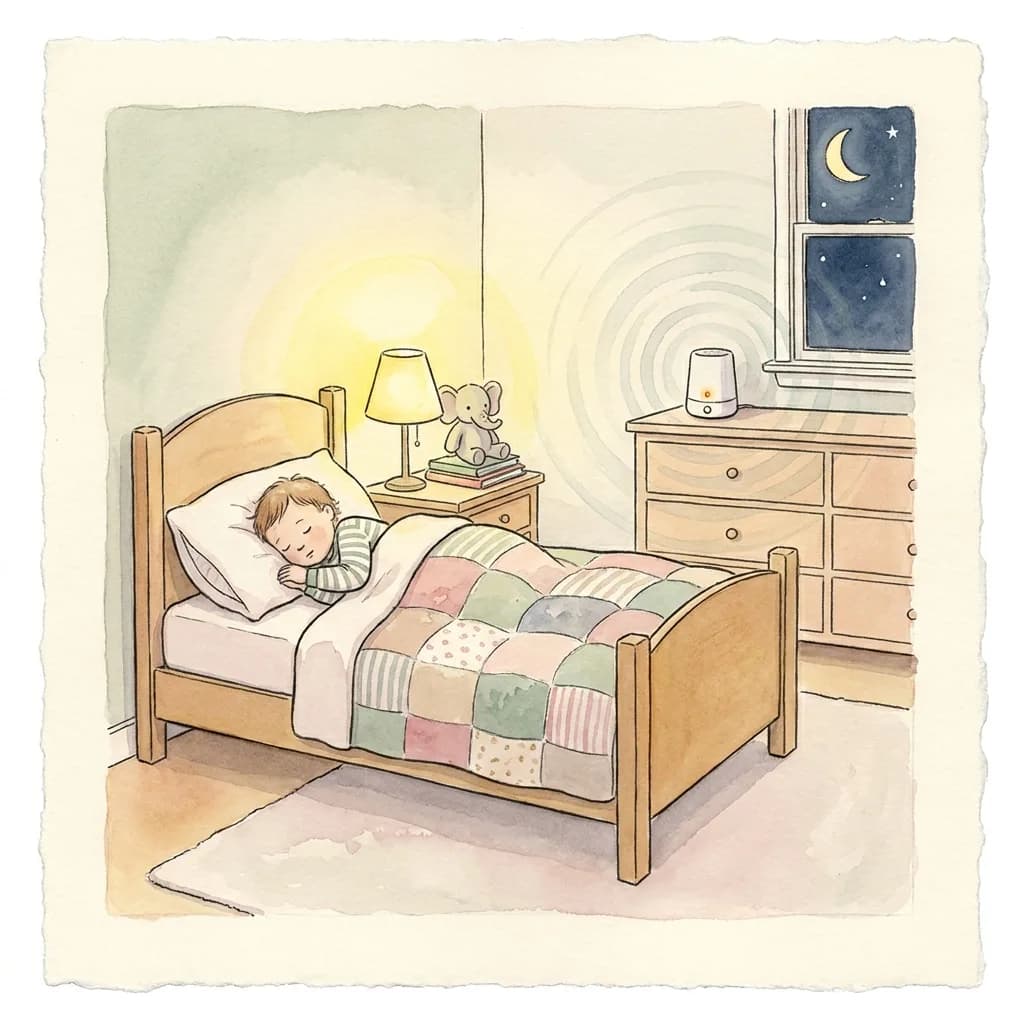
White Noise for Sleep: What the Research Says About Toddler Sound Machines
White noise can drop sleep onset by a measurable margin, and some popular machines can damage hearing if you put them where most parents do. Here's what the studies actually show, and the three settings that decide whether yours is helping or hurting.
The Machine on the Nightstand
The white noise machine is the most-bought sleep gadget in any nursery, and it usually lives about a foot from the kid's head. That's the part the box doesn't mention.
Done right, white noise shortens sleep onset and smooths over the kind of household sounds that wake a light sleeper. Done wrong, it's loud enough to be a hearing risk for an adult on an eight-hour shift, and it's pointed at a sleeping toddler all night. The product itself isn't the variable. Three settings are. This post walks through which ones matter and how to tell if yours is helping or quietly making things worse.
What the Research Actually Shows
White noise has more sleep research behind it than most baby-aisle products, and the findings are consistent across studies. It works. The catch is how it works and on whom.
The earliest controlled trial is still the cleanest one. Spencer and colleagues ran a randomized study of 40 newborns aged two to seven days. Sixteen of twenty (80%) fell asleep within five minutes when white noise was played, compared with five of twenty (25%) in the control group Spencer et al., Archives of Disease in Childhood, 1990. That's the gap that built the category. Newborns settle faster with steady ambient sound than they do in silence.
The adult evidence is consistent. Messineo and colleagues ran 18 healthy adults through a model of transient insomnia. Broadband sound cut the median time to stage 2 sleep by 38%, from 19 minutes to 13 minutes (p=0.011) Messineo et al., Frontiers in Neurology, 2017. People who reported trouble falling asleep at baseline got the biggest gains.
Across studies, the mechanism is auditory masking. Steady broadband sound raises the threshold at which a disturbing noise (a sibling's door, a passing truck, a creak) will register and pull the brain back toward wakefulness. It isn't sedating in any biochemical sense; it just makes the noise floor harder to cross.
What the research does not show: a reliable benefit for kids who already sleep well in a quiet room. Most of the controlled benefit is in the high-arousal cases (newborns, light sleepers, people on the edge of insomnia). For a toddler whose room is genuinely quiet and whose sleep is solid, a sound machine is usually a habit, not a help.
The Hearing Problem Nobody Reads About
The single most-cited paper on sound machines and kids is the one whose findings no one ever sees on the packaging.
In 2014, Hugh and colleagues at Toronto's Hospital for Sick Children measured 14 commercially available infant sleep machines at maximum volume, at distances of 30, 100, and 200 centimeters, using correction factors for a six-month-old's ear canal. All 14 machines exceeded 50 A-weighted decibels at 30 cm, the recommended noise limit for infants in hospital nurseries. Three machines exceeded 85 dBA at 30 cm. If a machine running at 85 dBA is played for more than eight hours, that exposure exceeds the occupational limits set for adults and starts to risk noise-induced hearing loss Hugh et al., Pediatrics, 2014.
Eight hours is the relevant number because that's roughly a toddler's overnight. A machine that's safe in a thirty-minute nap is not necessarily safe across a full night.
A 2024 scoping review of 20 studies (covering 9,428 human subjects across pediatric ages, plus animal models) reached a similar conclusion. White noise machines on maximum volume can exceed 91 dB, well over the National Institute for Occupational Safety and Health limit for a two-hour work shift in adults. The review found that low-intensity exposure during sleep appears to help, but continuous moderate-intensity exposure in animal models produced developmental effects on the auditory cortex that the authors flagged as cause for caution De Jong et al., Sleep Medicine, 2024.
The AAP's own broader noise guidance puts the threshold at 70 dB for damage from prolonged exposure and 120 dB for immediate harm, and notes that the 85 dB occupational adult standard should not be assumed safe for children AAP - HealthyChildren.org. Most popular machines on max volume sit somewhere in the 70 to 90 dB range at crib-edge distance. That's the part that should set your defaults.
The Three Settings That Matter
If you keep a white noise machine in your kid's room, the only choices that change the safety-and-benefit math are volume, distance, and duration. Everything else (color of light, type of noise, brand) is noise.
Volume: target 50 dB or below. That's roughly the level of a quiet refrigerator hum or a soft conversation in the next room. A free decibel meter app on your phone, held where your kid's head will be, will get you close enough. Children's National advises keeping a sound machine below 50 dB to stay in line with the hospital nursery standard Children's National. If you can hear it clearly from the doorway, it's louder than it needs to be.
Distance: across the room, not on the nightstand. Hugh's 2014 study found that none of the 14 machines exceeded 85 dB when measured at 200 cm (about seven feet) from the source. The further the machine sits from your kid's pillow, the more headroom you have on volume Hugh et al., Pediatrics, 2014. The default placement most parents pick (right next to the crib, on top of the dresser, or on the wall above the bed) is the worst case from a hearing-exposure standpoint.
Duration: most kids only need it for the first chunk of the night. The bulk of sleep-onset wake-ups happen in the first 30 to 90 minutes after lights-out. A machine on a timer that runs for about an hour catches that window and then turns off, which keeps total exposure low. If your toddler reliably wakes when the machine stops, leave it on for the full night at the lowest effective volume rather than fight a wake-up at midnight. The Hugh paper's own recommendation was to play machines well below max and shut them off after the baby falls asleep Hugh et al., Pediatrics, 2014.
A few mechanical things to check before you buy:
- The machine has a real volume knob with fine adjustment
- not just three buttons that all sound loud
- There's a sleep timer or auto-off (some machines run forever by default)
- The bulb or unit stays cool to the touch (these often run all night for years)
- It does not double as a night light
- projector
- or screen. A separate small unit beats a multifunction unit a toddler will fiddle with. For the lighting half of the question
- our deep-dive on the night light for toddler covers what color and brightness actually matter
- The sound is continuous
- not a looping clip that repeats every 30 seconds (looping audio has a small click most kids learn to anticipate
- and the anticipation itself becomes a wake-up cue)
When White Noise Is the Right Tool
The parents who get the most out of a sound machine usually fall into one of three buckets.
Your house is loud and your kid's room is in the loud part of it. Shared walls in an apartment, a sibling's bedroom on the other side, a TV in the living room, a dishwasher that runs after bedtime. White noise raises the threshold for those sounds to register. The masking effect is real and the studies on this case are the strongest.
Your kid is a light sleeper in the middle of a developmental shift. The toddler years stack new pressures on sleep, and a brain that's been working overtime on language and independence is a brain that wakes easily. Our walkthrough of the toddler sleep regression covers why this stretch hits when it does. A low-volume machine across the room can take some of the edge off the noisy-environment piece of a rough month.
Bedtime is contested and you're trying to make the room one consistent thing. The single biggest driver of toddler sleep quality is a stable routine. Mindell's 2015 analysis of more than 10,000 families found that bedtime routine consistency was dose-dependent with sleep outcomes across countries and ages. Every additional night per week with the same wind-down sequence meant earlier sleep onset, fewer wakings, and more total sleep Mindell et al., Sleep, 2015. A sound machine can be one of the cues that signals "this part of the day is over," provided it's the same cue every night.
Where white noise is the wrong tool:
- You're using it to drown out a kid who's not asleep because the routine collapsed. The routine is what's broken. White noise won't fix it. Our guide to a toddler bedtime routine is the first piece to put in place
- You're using it to cover the sound of conversation downstairs that you don't want to lower (lower the conversation; it's free)
- You think it'll help with fear of the dark. The fear is visual
- not auditory. A toddler scared at night needs the comfort intervention
- not a louder room
- You're using it as a sedative. It isn't one. The masking effect helps light sleepers stay asleep; it doesn't override a kid who has a reason to be awake
White Noise vs. Music vs. Stories
Parents often ask which of the three is best for toddler sleep. The honest answer is that they do different jobs and the right one depends on what part of the night you're trying to fix.
White noise is for masking. It's a constant, unchanging wall of sound that makes the rest of the auditory environment recede. It works best after lights-out, through the night, at low volume. It is not engaging on purpose. A toddler shouldn't be paying attention to it.
Music is for the wind-down. Calm instrumental music in the half hour before lights-out can lower arousal in a kid who's still wired from dinner and bath. The catch is that music that's pleasant for an adult is often stimulating for a toddler. Anything with lyrics, big dynamic shifts, or a hook your kid likes will engage their attention rather than settle it. If you go this route, stay instrumental and low-tempo, and turn it off when the kid is in bed.
Audio stories are for the bridge to sleep. A narrated story is the last engaged step before sleep onset. The voice gives the brain something to follow and slows it down, the way a parent reading aloud does, but the room can be dark and the kid can lie still. Once the story ends, the brain has somewhere to go besides looping on the day. For the audio step at the end of the routine, our bedtime stories app works in the dark with no screen. Luma the Little Cloud is a calm, drifting two-minute listen that pairs well with a low-volume sound machine staying on after the story finishes.
A working stack for a contested bedtime looks like this. Music low during bath and pajamas. Story in bed with the lights off. Sound machine on at low volume across the room as the story ends. Story plays a calm character through the noise-floor handoff that white noise can't do on its own. Taylor's Quiet Shell models the same idea explicitly: an overstimulated kid learning to find quiet inside a noisy world. That framing carries the routine more reliably than any single object in the room.
How to Wean Off It
Most toddlers don't need a sound machine for long. The ones who do are usually using it through a noisy season (a new baby in the house, a stretch of construction next door, a sibling room-share) and could let it go once the trigger fades.
A wean that tends to work:
- Drop the volume one notch every week or two. Most kids don't notice gradual changes
- Move the machine progressively further from the bed. If it's already across the room
- move it into the hallway
- Once it's running quietly in the hallway
- try a night without it. If the night is fine
- the wean is done. If it isn't
- put it back and try again in a few weeks
- Don't tie the wean to a sticker chart or a deal. Make it a quiet
- low-stakes thing your kid doesn't have to perform for
- If a regression or a move or a new sibling brings it back
- that's fine. The same wean works the second time
If you've been running the machine since the newborn months and your kid is now four and still using it, the machine isn't doing harm if the volume is low and it's far away. It is doing one thing though: it's making the kid dependent on a constant external input to stay asleep. That dependency travels. Hotels, grandparents' houses, the eventual sleepover. None of those rooms will sound like home. Weaning isn't medically urgent at any age, but it's easier at three than at seven.
If you're at the stage of life where you're juggling bed transitions, fear of the dark, and a sound machine all at once, the broader pattern of the toddler years is usually doing the work. The 2-to-3 stretch is its own thing. Our walkthrough of the 2 year sleep regression covers why imagination, separation anxiety, and bedtime fights tend to land in the same window.
The Boring Version of This Advice
White noise has real, replicated evidence for shortening sleep onset, particularly in newborns, light sleepers, and rooms with intermittent noise. The benefit is masking, not sedation. The machine doesn't make your kid sleepier; it makes the rest of the room less likely to wake them.
Three settings decide whether yours is helping or hurting. Keep the volume at or below 50 dB, place the machine across the room from the bed (seven feet is the well-tested distance), and run it only as long as needed (a timer that catches the sleep-onset window is often enough). The three machines in the 2014 Toronto study that exceeded 85 dB at 30 cm did so on their default settings; the problem was placement and volume, not the products themselves Hugh et al., Pediatrics, 2014.
If your toddler is sleeping well in a quiet room, you don't need a sound machine. If your house is loud or your kid is in a rough developmental stretch, a low-volume one across the room is one of the most well-supported environmental interventions in pediatric sleep. Like a night light or any other object, it's a small assist on the routine, not a replacement for it.
