
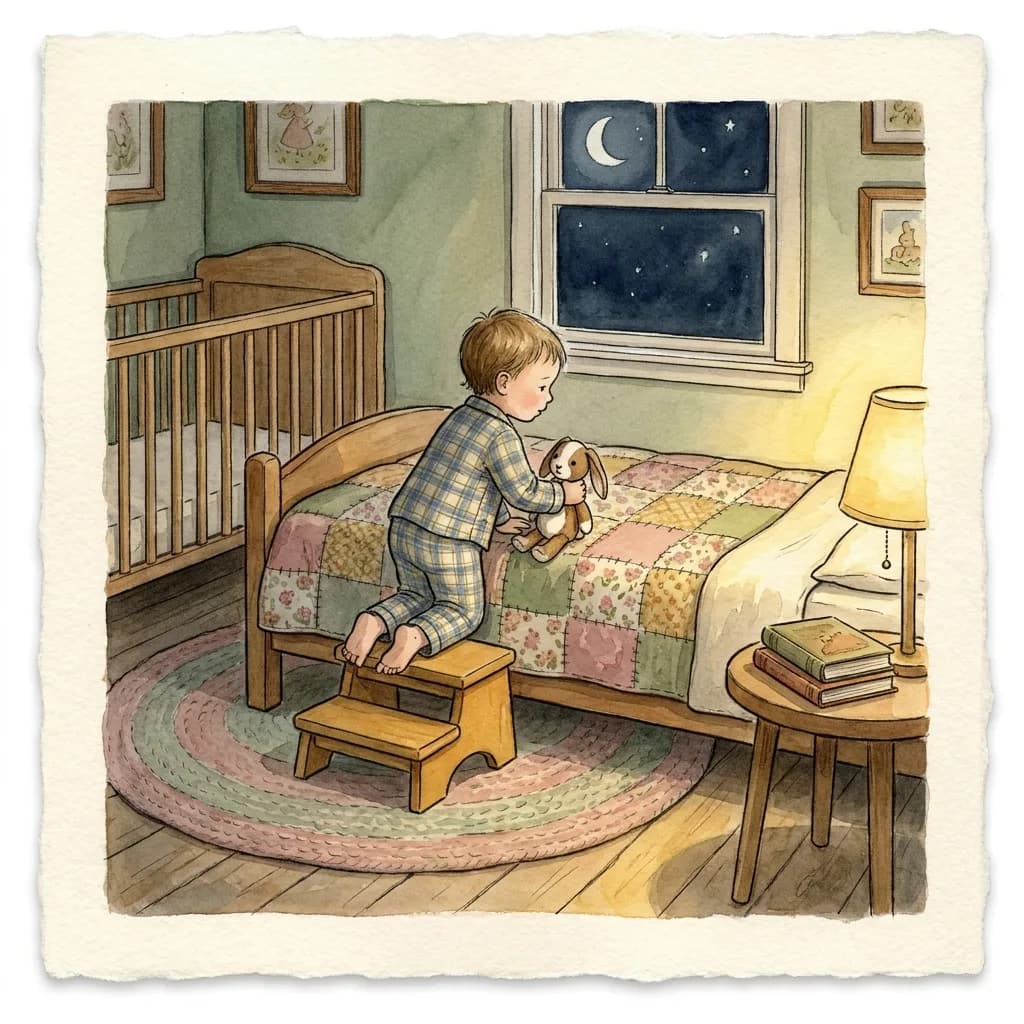
Moving Your Toddler From Crib to Bed: When (and How) to Make the Switch
Most parents make the crib-to-bed move too early. Here's what the AAP actually recommends, what the research shows about sleep after the switch, and the timing decisions that determine whether the next month is calm or chaos.
The Move Most Parents Make Too Early
You've been eyeing the toddler bed in the corner of the room for weeks. Maybe a younger sibling is on the way and you need the crib. Maybe your kid just turned two and it feels like the natural next step. Maybe a friend mentioned their kid is in a big bed and now you're behind.
Here's what the data says: most parents pull the trigger on this transition earlier than they need to, and the sleep cost is real. The crib-to-bed move is one of the few sleep decisions where the boring choice, wait, is also the right one. This post walks through the actual triggers that should move you, the ones that shouldn't, and how to run the switch without trading a sleeping toddler for two months of bedtime negotiations.
What the AAP Actually Says
The American Academy of Pediatrics gives two markers, not an age.
First, a height: "Once children are about 3 feet tall, they should start sleeping in a bed" AAP - HealthyChildren.org. Most kids hit 36 inches somewhere between two and three. A tall two-year-old might get there earlier; an average two-year-old usually won't.
Second, a behavior: "Once your toddler can climb out of their crib, it may be time to transition to a 'big kid' bed" AAP - HealthyChildren.org. The reason isn't preference. Falls are the most common crib-related injury, and most happen during a climb-out attempt.
Notice what the AAP doesn't say. It doesn't say two. It doesn't say three. It doesn't say "when the new baby comes." The triggers are physical, not emotional or logistical. If neither has happened, the crib is still working for you.
What the Research Shows About Timing
A 2018 study of 1,983 toddlers across five countries compared sleep outcomes between crib sleepers and bed sleepers in the 18 to 36 month window. The crib sleepers did better on essentially every metric Williamson et al., Sleep Medicine, NIH-PMC:
- About 29 minutes more nighttime sleep on average (37 minutes longer for 18 to 24 month olds)
- Bedtime roughly 12 minutes earlier
- Longest sleep stretch about 43 minutes longer
- Bedtime resistance reported in 29.1% of crib sleepers vs 63.9% of bed sleepers
- Sleep problems reported in 43.6% of crib sleepers vs 62.3% of bed sleepers
The size of that bedtime-resistance gap is the headline number. Moving a 22-month-old out of the crib roughly doubles the chance you'll be dealing with bedtime resistance. That's not bad luck. That's the developmental reality of putting a toddler with limited impulse control into a space they can leave at will.
How toddlers are actually distributed today, from a 2019 cohort study: 63.4% of 18 to 24 month olds were still in cribs, 34.3% of 24 to 30 month olds, and 12.6% of 30 to 36 month olds ParentData (Oster) citing Sleep Medicine. The median is sometime in the late twos. If you're holding out at 26 months, you are not behind.
The Two Real Triggers
Move when one of these is true. Wait when neither is.
Your kid is climbing out. This is the safety call. A crib railing that sits below your toddler's chest is a fall hazard, and a kid who has already gotten one leg over is going to keep trying. Some parents buy time with a crib tent or a sleep sack that limits leg lift, but if the climbing is consistent, the crib is done.
Your kid is 36 inches tall. Once they've hit roughly three feet, the crib's raised sides no longer give the protection they were designed to. AAP crib standards require at least 26 inches of rail above the mattress at its lowest setting AAP - HealthyChildren.org. Even a non-climber can clear that if they decide they want to.
The triggers that aren't really triggers:
- Your kid asked for a big kid bed (two-year-olds ask for lots of things they then change their minds about)
- A new baby is coming (handle this separately
- see below)
- Their friend got one
- They just turned two
- Potty training is starting (in fact
- doing both at once is a recipe for both going badly)
The Sibling Trap
One of the most common reasons families move a toddler out of the crib too early is that a younger sibling needs it. This is a logistics problem disguised as a sleep decision.
If a baby is on the way and the older toddler isn't yet at one of the AAP triggers, you have three real options. First: borrow or buy a second crib for the newborn. Cribs go cheap secondhand, and a newborn doesn't need the full setup right away. Second: keep the newborn in a bassinet in your room for the first three to six months, which is AAP guidance on sleep location regardless. That buys the older sibling time to grow into the transition naturally. Third: if you do move the toddler, give them the new bed at least six to eight weeks before the baby arrives, so the change doesn't get tangled with the new sibling in their head.
The thing to avoid is moving the toddler the same week the baby comes home. That stacks two of the most disruptive events of their life on top of each other, and the toddler will pin the change on the baby. Bedtime resistance and night wakings tend to spike in toddlers after a new sibling regardless of the bed situation. Adding a bed change on top makes it harder to tell which problem is which.
How to Make the Switch Without Losing Sleep
When the trigger does hit, the playbook is short and well-supported.
Keep the bedtime routine exactly the same. The single biggest predictor of how a transition goes is whether the routine survives it. Mindell's analysis of more than 10,000 families found that bedtime routine consistency was dose-dependent with sleep outcomes across countries and ages. Every additional night per week with the same wind-down sequence meant earlier sleep onset, fewer wakings, and more total sleep Mindell et al., Sleep, 2015. If the only thing that changes about bedtime is the bed, the routine is doing most of the work for you.
A few mechanical moves that pair well:
- Set the bed up days before the transition night so it isn't a surprise
- Use the same sheets and the same comfort object from the crib
- Put the bed in the same spot the crib was in if you can
- Keep the room dim through the whole routine. A 2022 study found that an hour of evening light suppressed melatonin in preschoolers by an average of 85% <a href="https://pubmed.ncbi.nlm.nih.gov/34997782/">Hartstein et al.
- J Pineal Research
- 2022</a>
- Childproof the room before night one: anchor furniture
- cover outlets
- install a gate at the door or top of the stairs
- If the new room is louder than the crib spot was (or a sibling is now sharing walls)
- our walkthrough of white noise for sleep covers the volume and placement settings that decide whether a sound machine helps or hurts
If you're choosing between a toddler bed and a twin, the bed itself matters less than how you set it up. Our breakdown of twin bed vs toddler bed covers the case for skipping the toddler bed entirely.
And keep the broader bedtime structure that's already working. If you don't have a wind-down sequence yet, our guide to building a toddler bedtime routine is the first thing to put in place, before the bed change, not after. For the audio step at the end of it, our bedtime stories app works in the new bed exactly like it did in the crib — The Bedtime Routine Race is a good first listen because it models a kid choosing to do the steps themselves, which is half the battle in the new big-kid bed.
When They Keep Getting Out of Bed
This is what every parent worries about, and it's the one part of the transition that goes badly more often than not.
Here's the AAP's actual advice, which is more direct than you'd expect: tell your child to stay in bed until you come for them. If they get out, calmly and quietly lead them back, and tell them they must stay in bed AAP - HealthyChildren.org. The article notes that "Twenty 'farewell appearances' in one evening is by no means an unusual number." They expect this to happen a lot before it stops.
The principle: any attention is better than none, so attention has to be neutral. No story, no negotiation, no extra cuddle when they pop out. Just the same calm walk-back, every time. Two-year-olds will test this 20 times. By the second week, most kids have stopped.
What not to do: don't lie down with them until they fall asleep, don't bring them into your bed to end the night faster, don't reintroduce a bottle or pacifier you'd already dropped. These all work in the moment and then become the new routine you have to undo. The same trap that sticks a 2 year sleep regression in place sticks a bad bed transition in place.
If your kid was already in the middle of a regression or going through a stretch of separation anxiety when you made the move, expect the adjustment to take longer, closer to four weeks than two. Resist the urge to undo the change. The crib doesn't fix what was already happening.
The Quiet Version of This Advice
If the crib is still working, leave it alone. The transition is one of the few sleep decisions with a clear sleep cost, and that cost lasts weeks to months. The two AAP triggers, climbing out or hitting 36 inches tall, are the only reasons that need to override "things are fine."
When the time does come, keep the routine the same, make the room safe, and accept that you're going to walk a small human back to bed roughly fifteen times on night one. That's the work. By the end of the second week, most of it is behind you. If your kid is closer to three than two when you make the switch, both of you will get a much easier landing. That's not opinion, that's what 3 year old bedtime looks like compared to the same kid at 22 months.
