
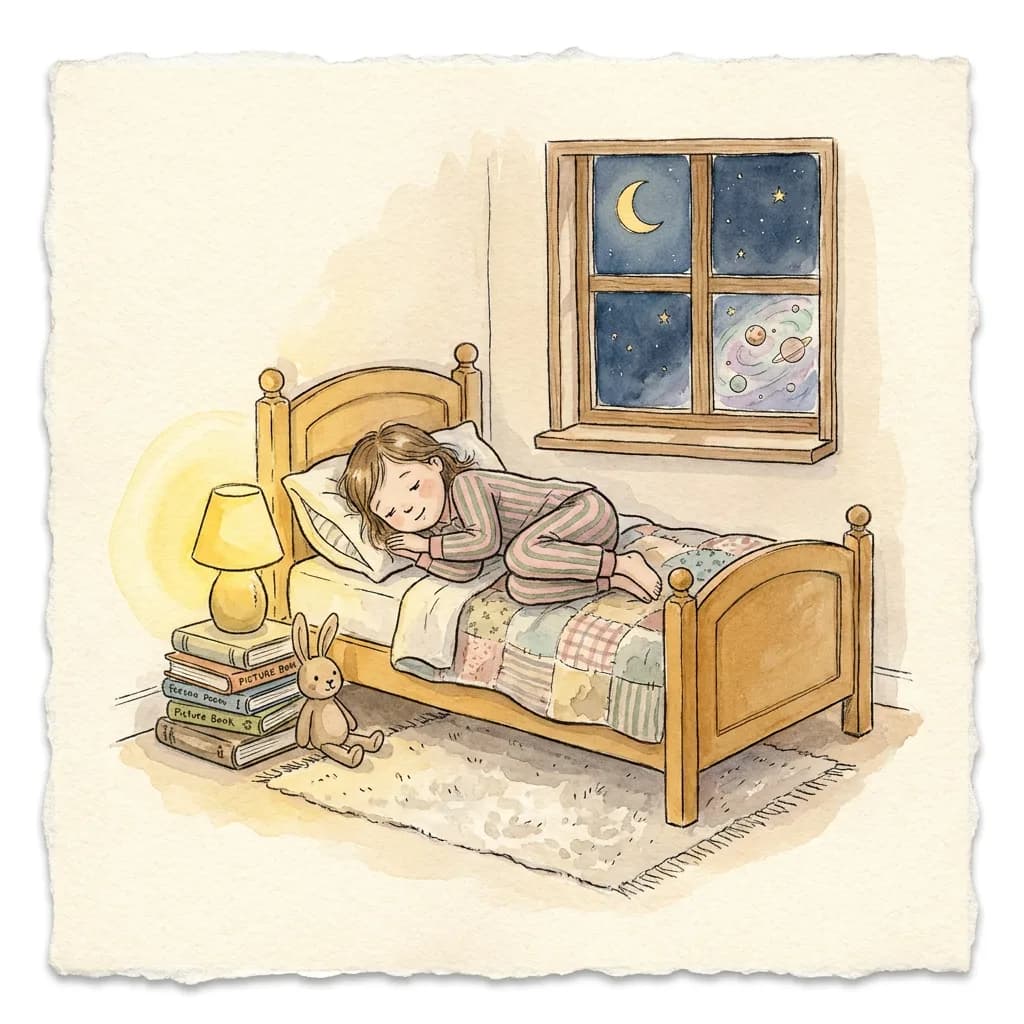
Bedtime Stories for 5 Year Olds: What Works at Kindergarten Age and What to Skip
Five-year-olds can follow a real plot, remember it the next morning, and ask for the same one again. Here's what kind of bedtime story works at kindergarten age, how long it should be, and how to pick one that settles them instead of winding them up before lights out.
Five Is When Stories Start to Get Bigger
At three, a bedtime story is one small character, one small problem, and a soft ending. At five, the same shape still works, but your kid can hold a lot more. Two characters in one story. A side plot. A theme that takes a minute to land. They can tell you what happened the next morning, what they thought the character should have done, and sometimes how the story should have ended instead.
Five-year-olds have the equipment for it. Vocabulary near ten thousand words, sentence structure that handles cause and effect, and a sturdier grasp of the line between pretend and real KidsHealth, Nemours. A bedtime story is finally something they can chew on. The catch is picking one that engages them at the new ceiling without dragging them past the part of the night where they should be winding down.
What a 5-Year-Old Can Actually Follow
Most five-year-olds can follow a story with two characters, a small problem, and an arc that takes a couple of minutes to resolve. They can also retell parts of a familiar story and predict what comes next in one they've heard before Reading Rockets, Pre-K Oral Language. That's a big jump from three, when a single character and a single problem was the ceiling.
What works at this age:
- One or two main characters with their own personalities
- A small problem with a clear before and after
- A theme like friendship or fairness or fitting in or trying again
- A familiar setting like a school playground or a bedroom or a starry sky
- A soft ending where the problem is settled and not just paused
What to skip at bedtime, regardless of how good the book is the rest of the day:
- Chase scenes or anything with a villain on screen the whole time
- Sudden loud moments or sound effects designed for laughs
- Cliffhangers and to-be-continued endings
- More than two new characters introduced in the last minute
- A surprise twist meant to land at the end
Five-year-olds are also old enough to ask the next question. What happens after the story ends, what the character will do tomorrow, what they would have done. Those questions are a good sign that the story landed. Save them for the morning. The bedtime version of the answer is short.
How Long a Bedtime Story Should Be at Five
Most five-year-olds settle well with a story in the eight-to-twelve-minute range. Long enough to carry a real arc, short enough to finish before they drift or start negotiating a second one.
The number isn't fixed. Some nights your kid will track a fifteen-minute story fine. Some nights, six is the ceiling. A useful test: if they can tell you something about the story the next morning, the length was about right. If they can only remember the start, it ran long.
The worry parents have, that an eight-minute story is too short for kindergarten-age, doesn't hold up. The benefit comes from the listening, not the runtime. Our guide to short bedtime stories covers length ranges by age and why short almost always wins at bedtime, the cornerstone post on bedtime stories for kids covers the case across ages one to eight, and bedtime stories for 4 year olds picks up the thread for the year before kindergarten. Our own short bedtime stories collection is filtered to the lengths that land in this window.
Stories Are Still Quietly Building Their Language
Five is when the vocabulary curve really starts climbing. School-age children pick up two to three thousand new words a year, sometimes more Dr. Karen Speech and Language. Bedtime stories are one of the small things that feed that climb directly.
A longitudinal study of 4,274 families found that preschoolers with regular language-based bedtime routines (reading, storytelling, or singing) slept about ten minutes longer per night and scored roughly 2.2 points higher on a standardized vocabulary test at age five Hale et al., Journal of Family Psychology. Two points sounds small. Spread across every night for two years right before kindergarten, it isn't.
Brain-imaging evidence backs it up. A study of preschool-aged children found that listening to stories activated regions tied to semantic processing and mental imagery, and that kids with more reading at home showed stronger activation in those areas Hutton et al., Pediatrics. A five-year-old listening to a story is doing real work. They're building the pictures themselves, and the practice carries over to how they'll read on their own a year from now.
The Imagination Is Sharper Now
The same imagination that lets a five-year-old follow a real plot also makes them better at scaring themselves. A widely cited parent-child study found that roughly 73 percent of children reported some kind of nighttime fear, with frequency staying high through the four-to-six year window before peaking again in early elementary school Muris et al., Behaviour Research and Therapy. Five-year-olds know more about the world than four-year-olds, and some of what they know is heavy. First questions about death, real worries from school, news they overheard.
A bedtime story is one of the better tools for this, but only the right kind. A story with a chase, a villain, or a sudden loud moment hands a kindergartener's imagination exactly the wrong material right before the lights go off.
Pick stories that stay calm the whole way through, that treat the dark and nighttime as ordinary and safe, and that end settled. Identity-and-belonging stories work especially well at five. Kindergarten is the year a kid first notices where they fit in a group, and a story that resolves the question gently is doing real work. Our deeper guide to a toddler scared at night covers the broader playbook for these fears. Pluto & the Dwarf Planets from our library is the shape we mean. Pluto loses his planet title and discovers a group of dwarf planets who treat the label as the wrong thing to worry about.
Why Audio Stories Still Win on Tired Nights
Reading aloud from a book is the gold standard when you have the energy. On the nights you don't, audio stories hold the same slot in the routine without the screen.
The screen part matters more than it seems, especially at this age. A 2022 study of preschool-aged children found that one hour of ordinary evening room light suppressed melatonin by an average of around 85 percent, and most kids' melatonin stayed below baseline for nearly an hour after the light went off Hartstein et al., Journal of Pineal Research. A tablet held close to the face is far brighter than that. An audio story plays in the dark.
Audio also suits how a five-year-old listens. With no screen, they build the pictures in their own head, which is a quieter and more internal kind of attention than watching. The story is the length it is. No flipping back, no "one more," no negotiating. It ends, and the room stays quiet. Lemonade Lane is a good companion pick, a gentle lesson on patience and saving that lands cleanly without ever needing a chase scene. Our bedtime stories app is built for exactly this kind of night, and the full story library is sorted by theme so a tired parent doesn't have to scroll.
Kindergarten Sleep Has a New Bar
At five, the night is doing more of the work than it used to. The afternoon nap is gone for nearly everyone. A 2020 meta-analysis found that about 94 percent of five-year-olds no longer nap on a regular basis Staton et al., Sleep Medicine Reviews. Whatever sleep they get has to come from the bedtime block.
A study in Pediatrics tracked children through their kindergarten year and found that kids who consistently got 10 or more hours of nighttime sleep, especially in the months before kindergarten started, did better across socioemotional development, learning engagement, and academic performance Teti et al., Pediatrics, 2022. The 10 hours had to come at night. Total sleep across 24 hours, naps included, did not predict the same benefits.
That makes the story a bigger deal than it used to be. Anything that pulls bedtime earlier and pulls a kindergartener into the dark calmer is doing work toward that 10-hour line. Our walk-through of a 5 year old bedtime covers the schedule side of this, and the broader toddler bedtime routine piece covers what to keep and what to drop as the day shrinks.
The Story Is the Anchor of the Routine
The single most reliable thing you can do for a five-year-old's sleep is a short, predictable bedtime routine, done the same way every night. The story is usually its anchor.
Jodi Mindell's international study of more than 10,000 families found a dose-dependent relationship between routine consistency and child sleep: more nights of the same routine produced earlier bedtimes, shorter sleep onset, fewer night wakings, and longer total sleep Mindell, Sleep 2015. The size of the effect grew with how often the routine actually happened. A routine you can hit seven nights a week is worth more than a routine you can only manage three.
That's the case for keeping the story consistent. Same spot in the sequence, after teeth and pajamas, right before lights out. Reading the book yourself and pressing play on an audio story both count. The American Academy of Pediatrics' 2024 literacy policy recommends shared reading from birth through at least kindergarten as part of routine pediatric care AAP, Pediatrics 2024. The five-year-old version of this is the same as the three-year-old version. The story happens, every night. The form it takes is up to you.
The Tonight Version
If you want to try this without overhauling anything: tonight, pick one calm story about the length of two or three songs. It doesn't need to cost anything; the free bedtime stories in our library work fine. Read it or play it after teeth and pajamas, in the dark, in the same spot every night. Don't add a second one when they ask, and they will ask.
Give it a week. Most kindergarteners settle into the new ending faster than parents expect, partly because a finished story is nothing to argue with. It starts, it ends, the lights stay off. The story does the work. The routine holds the night.
