
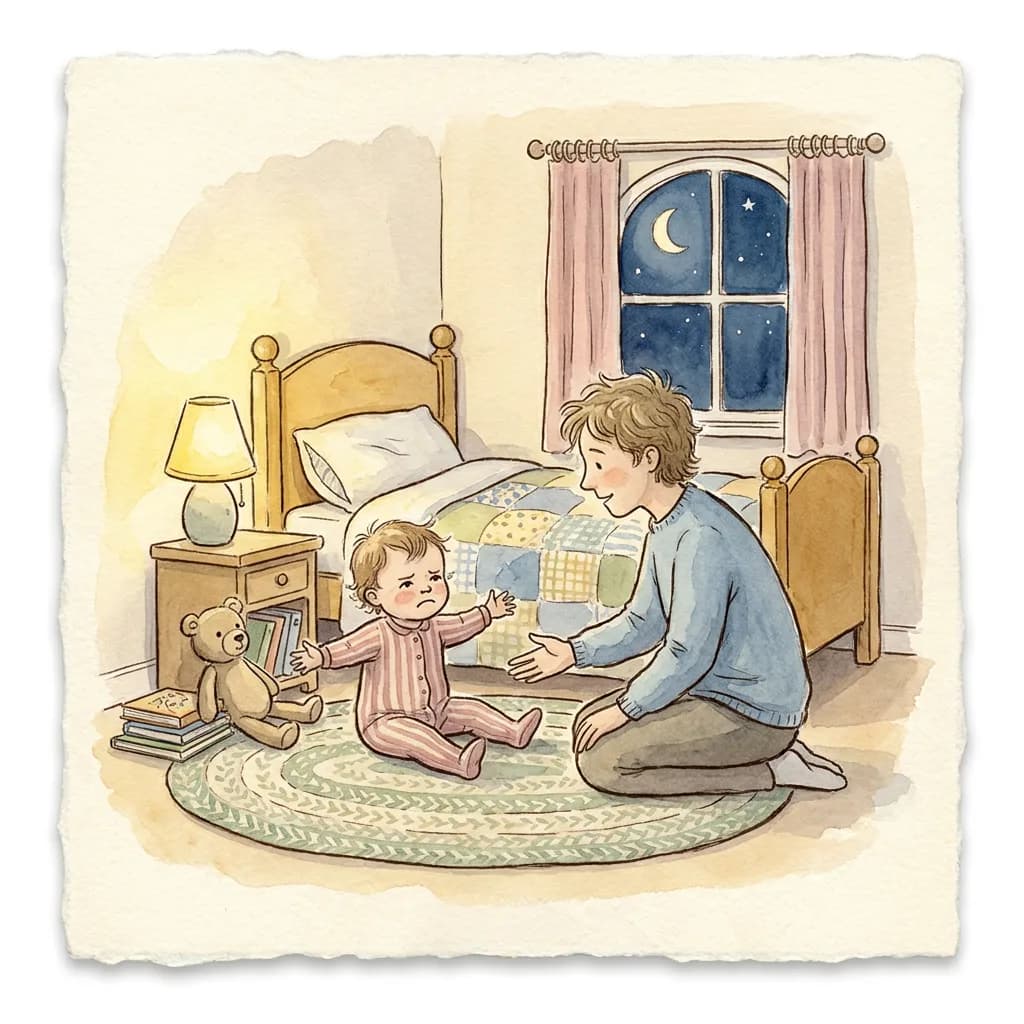
Bedtime Tantrums: Why They Happen and How to Make Them Shorter
A toddler who is fine all day melts down the moment bedtime starts. Here's why bedtime is tantrum prime time, what makes a tantrum longer, and what actually shortens it.
The Meltdown That Only Happens at 8 PM
Your toddler had a good day. They shared a toy, ate most of dinner, laughed at something on the walk home. Then you said the word "bath" and the whole thing came apart. Now they're on the floor, arched and shrieking, and you're standing over them wondering how a calm evening turned into this in under a minute.
Bedtime tantrums are their own specific kind of exhausting, because they land at the exact moment your patience is lowest and the day is supposed to be ending. The good news is that they are extremely common, they follow a predictable pattern, and most of what makes them long is changeable. This post covers why bedtime is tantrum prime time, what quietly stretches a tantrum out, and what actually shortens it.
Why Bedtime Is Tantrum Prime Time
Tantrums in general are close to universal at this age. They occur in 87% of 18- to 24-month-olds and 91% of 30- to 36-month-olds, and the most common stretch is between two and three StatPearls - NCBI Bookshelf. Bedtime is where a lot of them land, because four things stack up at once right at the end of the day.
The day's fuel is gone. By 7 or 8 PM a toddler has been regulating their feelings for twelve straight hours, and the tank that handles frustration is close to empty. A request that would have gotten a shrug at noon gets a meltdown now.
Bedtime is a transition, and transitions are hard. Going from play mode to sleep mode means stopping something they like and starting something they didn't choose. A toddler study of bedtime resistance found that 61.3% of toddlers fight, stall, or resist at bedtime, and that the youngest toddlers were the most likely to cry or tantrum about it specifically Behavioral Topography of Bedtime Resistance, SLEEP, 2022.
Bedtime is also where autonomy collides with the schedule. Toddlers are working hard on being their own person, and bedtime is one of the few daily events that is completely non-negotiable. The tantrum is partly a protest about who gets to decide.
And the imagination is loudest at night. The same developmental leap that brings tantrums also brings nighttime fear. If your toddler's meltdowns come with talk of monsters or the dark, the tantrum may be fear wearing a louder costume, which our guide to a toddler scared at night gets into.
A Tantrum Is Not a Strategy
The thing to hold onto when your toddler is screaming on the floor: this is overflow, not a plan. The part of the brain that handles logic, impulse control, and calming yourself down is the prefrontal cortex, and at two and three it is years from finished. A toddler in a full tantrum has lost access to it. They are not running a negotiation. Their nervous system hit capacity and the only output it has is volume.
Language makes this worse at exactly this age. A toddler feels far more than they can say, and when the feeling outruns the words, the gap comes out as a tantrum. Children with more limited expressive language tend to have more frequent tantrums, driven by the frustration of not being understood StatPearls - NCBI Bookshelf. Bedtime is full of big feelings (missing you, not wanting the day to end, fear of the dark) and very few of them are ones a toddler can name.
This reframe matters because it changes your job. You are not there to win an argument or correct a behavior. You are there to be the calm, steady thing in the room while a small nervous system finishes a wave it cannot stop on its own.
Tired Makes Everything Worse
Overtiredness is the single biggest amplifier of a bedtime tantrum, and it is also the most fixable. An overtired toddler does not look sleepy. They look wired, hyper, and resistant, which is the opposite of what tired is supposed to look like, so it is easy to read it as a behavior problem instead of a sleep problem.
What is happening underneath is physiological. When a toddler is pushed past their window, stress hormones rise, and that makes settling harder, not easier. Research on toddlers found that those with poorer, more fragmented sleep had higher awakening cortisol and scored worse on anger and inhibitory control, while toddlers who slept well scored lower in anger and higher in self-control Sleep Quality, Cortisol, and Behavioral Regulation in Toddlers, 2016. Poor sleep and big feelings feed each other, and bedtime is where the loop is most visible.
The practical takeaway is to start the wind-down earlier than feels necessary. A toddler who hits the bedroom already past their limit has nothing left to manage the transition with. Catching them on the right side of that window prevents far more tantrums than any in-the-moment technique. If your toddler regularly seems to fight sleep hardest right when they need it most, our post on a toddler fighting bedtime covers the overtired trap in more depth.
The Moves That Make a Tantrum Longer
Almost everything that stretches a bedtime tantrum out is something a worn-down parent does at 8 PM to make it stop faster. Each move works in the moment. The cost shows up later.
The patterns that backfire:
- Matching their volume: raising your voice tells their nervous system the room is unsafe
- which keeps the alarm on
- Reasoning mid-tantrum: explaining why sleep matters lands on a brain that is offline for logic right now
- Giving in to end it: if the tantrum buys a later bedtime or one more show
- the tantrum just became a working tool
- Adding new steps to buy quiet: one more book
- one more drink
- one more song
- until a 30-minute routine has ballooned to 90
- Bouncing in and out of the room: each return resets the clock and teaches them that protest brings you back
None of these ruin anything as a one-off. A rough night met with extra comfort is fine. The trouble is that toddlers update their model of bedtime fast. Whatever ended the tantrum last night is what they will reach for tonight, so the pattern you accidentally rewarded becomes the pattern you get. The goal is not to be harsh. It is to be predictable enough that your toddler can stop testing what the rules are.
What Actually Shortens a Bedtime Tantrum
Once the tantrum is already happening, you cannot talk your toddler out of it, and trying tends to extend it. Your job shrinks to something simpler: stay calm, stay close, and let the wave pass.
In the moment:
- Lower your voice and slow down instead of speeding up; your calm is the signal their nervous system is reading
- Get down to their level and stay nearby so they are not alone with the feeling
- Name the feeling in a few plain words: "You're so mad it's bedtime. I know."
- Stop talking once you've said it; narration during a tantrum is just more input to a flooded brain
- Hold the limit gently: bedtime is still happening
- you are just helping them get there
Most tantrums are shorter than they feel. The median tantrum in toddlers runs about three minutes, and the most common length is under a minute StatPearls - NCBI Bookshelf. When you stay steady instead of escalating, you let it run its natural short course. When you fight it, you give it fuel and a reason to keep going. If the meltdown is more screaming than rage, or it tips into sad, teary clinging, our guide to a toddler screaming or crying at bedtime covers both versions, which need more connection than limit-holding.
Prevent the Conditions: A Routine That Holds
The most effective tantrum tool is not used during the tantrum. It is the wind-down that happens before one can start. A predictable routine removes most of the things a bedtime tantrum is protesting: the surprise, the abrupt stop, the sense that something is being done to them.
The research on this is strong. In a study of over 400 families, simply adding a consistent nightly bedtime routine cut toddlers' night wakings from 1.3 to 0.6, shortened the time they spent awake at night, and lengthened their longest stretch of continuous sleep, with mothers' mood improving alongside it Mindell et al., SLEEP, 2009. The routine itself, done the same way every night, is the intervention.
What lowers the odds of a tantrum before bedtime even starts:
- Start the wind-down 30 to 60 minutes earlier than feels necessary
- so you catch your toddler before the overtired wall
- Cut stimulating play and screens well before bath; a revved-up toddler cannot downshift on command
- Keep the routine short
- identical
- and in the same order every night so nothing is a surprise
- Offer small real choices inside the fixed frame: blue pajamas or green
- this book or that one
- so the autonomy need gets met without moving bedtime
- Give a clear warning before each transition: "Two more minutes
- then we clean up
- " so the stop is never a shock
- End on something calm and external
- like a quiet story
- so the last thing in the room is soothing rather than another demand
A steady routine will not erase every tantrum, and it should not have to. But it shrinks the number that start and the length of the ones that do. For a full walk-through of what to keep and what to drop, our guide to a toddler bedtime routine is the place to start. For the calm story at the end of it, our bedtime stories app has multi-character narrated audio sized for this slot — Counting Clouds with Coco walks toddlers through guided breathing and Mood Balloon Parade names big feelings without lecturing.
When to Talk to Your Pediatrician
Bedtime tantrums are a normal, near-universal part of the toddler years, and most ease as language and self-regulation catch up. A few patterns are worth raising with your pediatrician:
- Tantrums that last well beyond 15 minutes and happen several times a week
- week after week
- Tantrums that regularly involve hurting themselves or others
- Meltdowns that have spread well past bedtime and are affecting daytime mood
- eating
- or play
- Loud snoring
- mouth breathing
- or pauses in breathing during sleep
- which can disrupt sleep and feed daytime dysregulation
- A toddler who seems unable to recover or be comforted long after the tantrum should have passed
These are not common, and naming them is calibration, not alarm. A pediatrician can help you sort a normal loud phase from something that would benefit from extra support, and asking is never an overreaction.
The Short Version
Bedtime tantrums happen because four things land at once at the end of the day: an empty regulation tank, a hard transition, a fight for autonomy, and a loud imagination. The tantrum is overflow from a brain that is still years from being able to calm itself, not a strategy you need to outsmart. Tiredness makes all of it worse, so start the wind-down earlier than feels necessary. In the moment, lower your voice, stay close, name the feeling, and let the short wave pass instead of feeding it. Most of the real work happens before bedtime: a calm, identical routine prevents far more tantrums than any in-the-moment trick. It is loud, it is exhausting, and it passes.
