
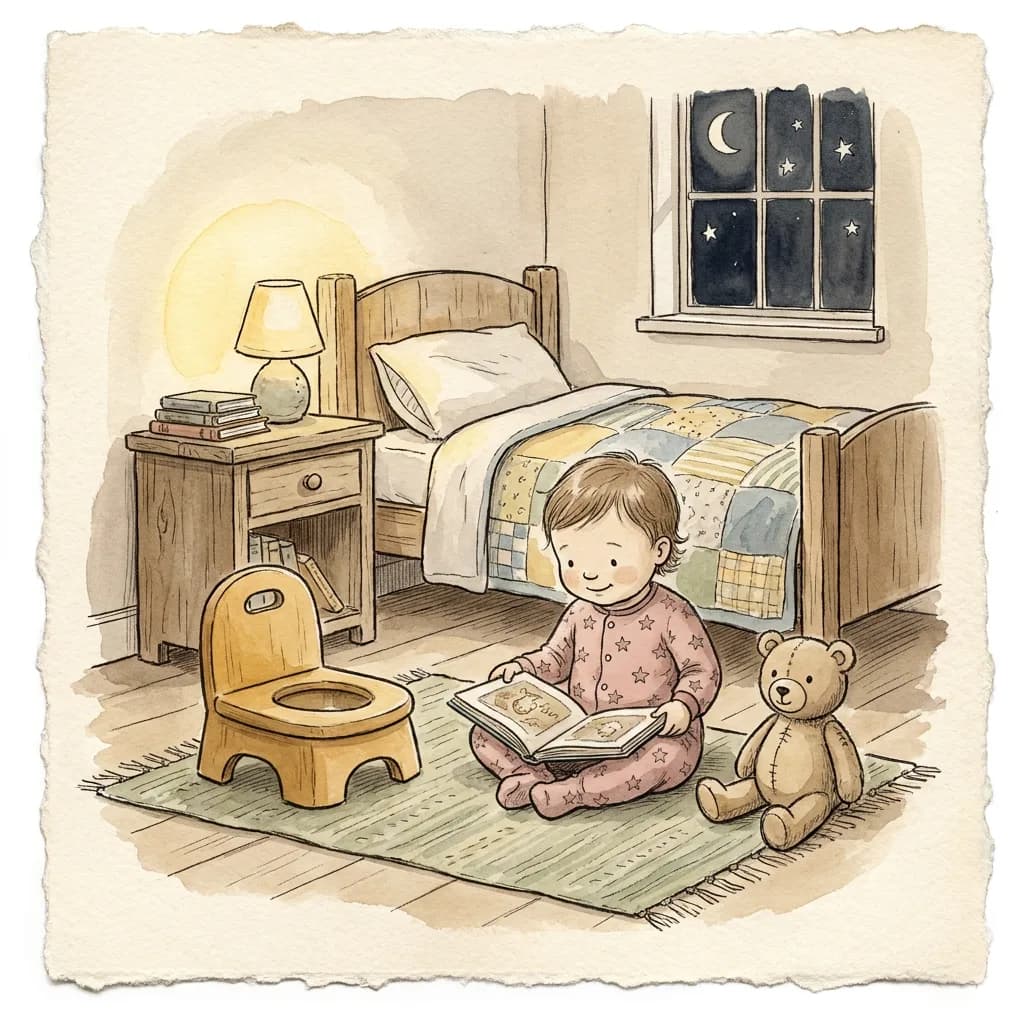
Potty Training Stories: How a Good Story Makes the Whole Thing Easier
A toddler will fight a lecture about the potty and happily sit through a story about it. Here's why potty training stories work, what makes a good one, and where they fit in the day.
The Toddler Who Won't Hear a Word About It
You have explained the potty. You explained it cheerfully, and then again a little less cheerfully. Your toddler heard none of it, or heard it and wandered off. Direct instruction has a low ceiling at this age, and potty training is one of the first places parents run into that wall hard.
A story gets in where a lecture bounces off. The same toddler who will not sit still for a how-to will happily sit through a story about a small character who is also figuring this out. The information is the same. The packaging is the part that changes whether any of it lands.
This post covers why potty training stories work, what the research actually shows, what makes a story worth reading, and where it fits into a day that already has plenty going on.
Why a Story Gets In Where a Lecture Doesn't
Toddlers learn enormously by watching. A story is watching with the stakes removed. Reading about another kid, or a bunny, or a dump truck using the potty lets your child rehearse the whole thing from a safe distance, with none of the pressure of their own body in their own bathroom.
There is research underneath this. In a study of three-year-olds, children who were read a picture book showing a character using a calming strategy went on to use that strategy more themselves afterward Picture Book Reading and Emotion Regulation, 2023. A story is not only entertainment in the moment. A child can carry the behavior in it out into their own day.
The other thing a story does is make the potty ordinary. A toddler being told to use the potty can feel singled out, like a new rule has been invented just for them. The more they hear that everyone does this, in book after book, the more it settles into the background as a normal thing people do.
Stories Work Best Before Training Starts
The most useful stretch for potty training stories is the lead-up, the weeks before you formally start anything. Stories during this window do quiet prep work, so that by the time the potty actually appears it is a familiar idea rather than a surprise.
It helps to know the real timeline here. The average age toilet training begins in the United States is between two and three years old, and starting earlier rarely speeds up the finish The Right Age to Toilet Train, AAP HealthyChildren. One large review found daytime continence was reached at a mean age of 28.5 months across 1,170 children Toilet Training Children, Paediatrics & Child Health, 2011.
Readiness is the thing to watch, not the birthday. A study of healthy toddlers found the signs that best predicted training success were expressing awareness of needing to go, being able to pull clothes up and down, and finishing simple tasks independently Development Signs and Toilet-Training Readiness, 2020. Stories will not manufacture those skills, but they keep the idea warm so it is ready to meet the skills when they show up.
What Makes a Good Potty Training Story
Not every potty book is a good potty book. The ones that work tend to share a few traits.
- A character close to your child's age or stage
- so they can see themselves in it
- Plain language for the actual steps: feeling the urge
- getting to the potty
- sitting
- wiping
- washing hands
- A calm tone rather than a cheering one
- since the goal is to make the potty ordinary and not exciting
- Accidents shown as a normal part of the process
- not a failure and not a punchline
- An ending that resolves gently
- with no big lesson stapled onto it
That last point matters most. A story that turns into a lecture stops being a story, and a toddler can feel the switch the moment it happens. The best ones teach by showing and then get out of the way. Our post on gentle lessons through storytelling goes into why a lesson lands harder when nobody announces it.
Where Potty Training Stories Fit in the Day
There are two good slots for these stories. The first is the potty itself. One of the real challenges of training is keeping a toddler seated long enough for anything to happen, and a story is the calmest way to buy that time. Even clinical toilet-training guidance notes that parents may talk or read a story while a child sits Toilet Training: Common Questions, AAFP, 2019.
The second slot is the bedtime routine. Story time is already part of a good toddler bedtime routine, which makes it an easy place to slip in a potty story without any pressure attached. Nobody's body is on the line at 7:30 PM, so the idea goes in gently while your toddler is calm and listening.
Bedtime is also where audio stories earn their keep. A read-aloud is wonderful when you have the energy, but on the empty nights a calm audio story keeps the routine intact without asking anything of you. Our guide to toddler stories that actually help at bedtime covers what to look for, and our own bedtime stories app has a small library of multi-character narrated stories built around that same gentle-lesson shape — the library is sorted by theme.
Stories Help With the Part Nobody Warns You About
Potty training is rarely a clean line from diapers to done. Accidents and setbacks are common, and clinical guidance notes that stool toileting refusal happens in up to 20% of children Toilet Training: Common Questions, AAFP, 2019. None of that means anything has gone wrong. It is just what the middle of the process looks like.
A story that already showed an accident as no big deal hands your toddler a script for the real one. They have seen the character spill, hear that it is fine, watch them try again. When it happens to them, it is a thing that has a known ending rather than a small disaster.
It gives you a script too. AAP guidance is to keep the whole process positive and to avoid a power struggle, because children ultimately control when and where they go The Right Age to Toilet Train, AAP HealthyChildren. A story keeps the topic light. It carries the message so you do not have to deliver it out loud for the hundredth time, which is usually the point where the power struggle starts.
What a Story Can't Do
A story is a tool, not a method. It cannot make a toddler ready who is not ready, and reading ten potty books to an 18-month-old will not move continence up. The physical control arrives when it arrives Toilet Training Children, Paediatrics & Child Health, 2011.
Some patterns also sit outside what a story can reach. If your toddler is regularly withholding stool, painfully constipated, or genuinely distressed by the whole subject, that is a conversation with your pediatrician rather than a story problem. Stool toileting refusal needs extra support in a meaningful share of cases, and a doctor can help you sort a normal rough patch from something that needs a different approach.
Used in the right place, though, a story is the gentlest part of an otherwise messy stretch of the toddler years. It does the explaining, the normalizing, and the rehearsing, all without a single negotiation.
The Short Version
Potty training stories work because toddlers learn by watching, and a story is watching with the pressure removed. Research shows children can pick up a behavior they see modeled in a picture book, and stories also make the potty feel ordinary instead of like a rule invented just for them. Use them in the weeks before you formally start, since readiness arrives on the child's timeline and not the calendar's. Look for a relatable character, plain language for the steps, a calm tone, accidents shown as normal, and no lecture bolted on. Read them on the potty to keep your toddler seated, and read them at bedtime to keep the idea warm. A story will not make an unready child ready, but it carries the message so you do not have to keep delivering it. It is the calm part of a process that has very few calm parts.
