
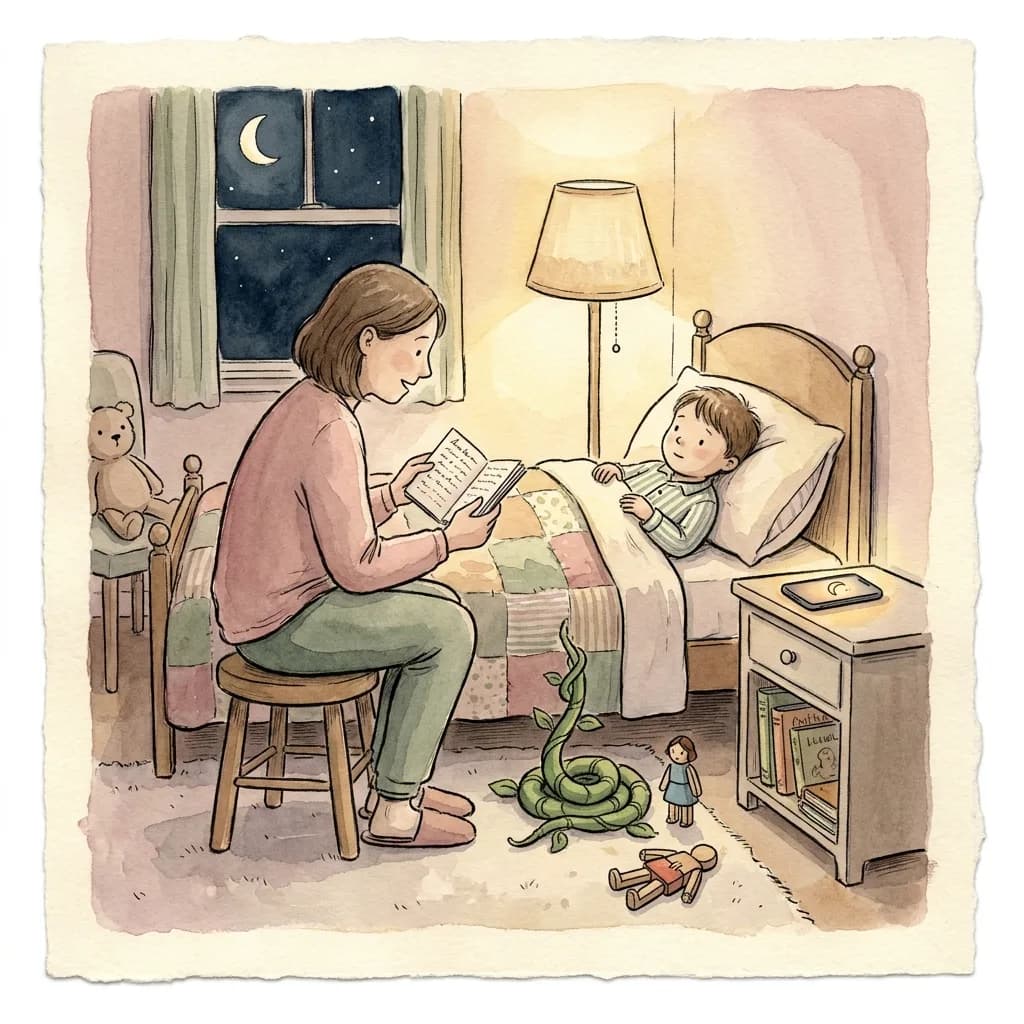
AI Bedtime Story Generator: How to Make Personalized Stories That Still Feel Calm
An AI bedtime story generator can turn a child's interests into a custom story, but bedtime still needs guardrails. Here is how to use one without making the night louder.
The Short Answer
An AI bedtime story generator is useful when it makes the bedtime story easier to start, not when it turns bedtime into a prompt-writing session. The best version asks for a few calm details, gives the parent control, and ends with a story that can be read or played without keeping the screen in the room.
Personalization should stay small: a child's name, one favorite animal, one feeling, one setting, one soft ending. That is enough. A bedtime story does not need ten characters, a twist, a battle, or a lesson spelled out in capital letters.
The adult still matters. The American Academy of Pediatrics says shared reading from birth through at least kindergarten helps build language, literacy, cognitive, and social-emotional development because the relationship is part of the reading AAP early literacy guidance. AI can help make the story. It should not replace the parent as the person choosing, checking, and carrying the routine.
What an AI Bedtime Story Generator Actually Does
A bedtime story generator is usually a simple form wrapped around a writing model. You give it a prompt, such as a child's age, a theme, a favorite creature, or a bedtime problem. The tool returns a short story based on those inputs.
That sounds new, but the bedtime job is old. The story still has to do the same work as a board book or an audio story: slow the room down, give the child one small emotional path, and end cleanly.
For bedtime, the useful controls are plain:
- Age range
- Story length
- Theme or feeling
- Main character
- Energy level
- Read-aloud or audio format
The mistake is treating the generator like a toy box. If every detail goes in, the story gets busy. If the prompt stays small, the story has a chance to stay calm.
What to Personalize
Good personalization makes the story feel close without making it hyperactive. The child should recognize one or two details and then relax into the plot.
Start with this:
- A first name or nickname
- A favorite animal or object
- A familiar place such as a bedroom or garden
- One feeling such as patience or feeling left out
- A soft problem that can be solved before lights out
Skip details that make the story feel like a recap of the whole day. A story about the argument at breakfast, the classmate who grabbed a toy, and tomorrow's dentist appointment may be relevant, but it is too hot for bedtime. Save that for a daytime story or a parent conversation.
If you want a broader guide to custom story shape, our older post on personalized bedtime stories covers why familiar names and gentle details can make a story feel more connected.
The Parent Is Still the Editor
AI-generated bedtime stories need a parent pass before they reach the pillow. That is not a technical objection. It is a bedtime objection. A model can write a story that is grammatically fine and still wrong for 8:05 p.m.
Read for three things before you use the story:
- Energy: no chases or threats and no cliffhangers or surprise endings
- Fit: the child can understand the words without a lesson speech
- Ending: the last paragraph moves toward rest instead of another question
The AAP's updated media guidance pushes families away from simple screen-time counting and toward quality, context, and conversation, including privacy and healthy limits around digital tools AAP digital media guidance. That is the right lens here. The question is not whether AI is allowed at bedtime. The question is whether this specific story helps this specific night end.
Privacy Comes Before Cute Details
Personalized bedtime stories create an obvious privacy question: what are you asking the tool to collect?
COPPA applies to operators of websites and online services directed to children under 13, and to operators with actual knowledge that they are collecting personal information online from a child under 13 FTC COPPA rule summary. The FTC's compliance guidance lists names, online contact information, persistent identifiers, photos, audio files with a child's voice, precise geolocation, and other combined identifiers as personal information under COPPA FTC COPPA compliance plan.
That does not mean a parent can never use a child's name in a story. It means the product design matters. Parents should know what is collected, why it is collected, whether it is stored, and whether it is used to train or target anything.
A practical rule: use the least personal detail that still makes the story work. A nickname and a favorite frog are usually enough. Full names, school names, addresses, photos, and voice uploads do not belong in a casual bedtime prompt.
Where Gushi Fits
Gushi offers finished bedtime stories. Its public story library lets parents read a story and check its themes before choosing it for the evening.
Narration is available in the Gushi bedtime stories app. Choose a story there for multi-character audio, or read the text aloud from the website.
If you use an AI writing tool to make your own story, use a finished story as a reference for length and structure. Ask for a simple problem and a gentle ending, then review the result before reading it to your child.
A Story Shape to Copy
A good generated bedtime story usually has one small problem and one kind resolution. In Gushi, Jack & the Wondervine is a useful shape to copy: a child starts with a broken toy, finds a gentle imaginative path, and ends with repair instead of noise.
That is the target for an AI bedtime story generator. The detail can be personal. The arc should stay simple. A child can bring a favorite toy, a favorite color, or a favorite animal into the story without turning the night into a full adventure.
What to Avoid
Most bad AI bedtime stories fail in the same way. They try to prove they can write. Bedtime needs the opposite.
Avoid prompts that ask for:
- An epic adventure
- A surprise twist
- A moral lesson
- A villain
- A funny ending
- A long list of favorite things
- A story that continues tomorrow
Also avoid using the generator while the child watches every choice. That puts the screen, the negotiation, and the possibility of infinite revisions right at the end of the routine. The AAP recommends keeping screens out of children's bedrooms at night and turning screens off at least one hour before bedtime to protect sleep AAP healthy sleep habits.
Make the story earlier if you are generating it. Use it later if you are reading or playing it.
The Tonight Version
If you want to try this tonight, keep the prompt tiny: name, age, one calm theme, one favorite detail, five minutes or less, no scary parts, soft ending.
Then read it once before your child hears it. Cut anything loud. Cut anything confusing. Cut anything that invites a sequel. If the story still feels like bedtime, use it after pajamas and teeth, then put the screen away.
An AI bedtime story generator is at its best when it disappears into the routine. The child hears a story that feels like theirs. The parent keeps the night simple. The room keeps getting quieter.
