
18 Month Sleep Regression: What's Actually Going On at 18 Months
Your one-year-old was sleeping well, and then a month before their second birthday it all fell apart. Here's what's actually happening at 18 months, what the research says about teething and regressions, and what makes a rough stretch stick.
They Were Sleeping Fine
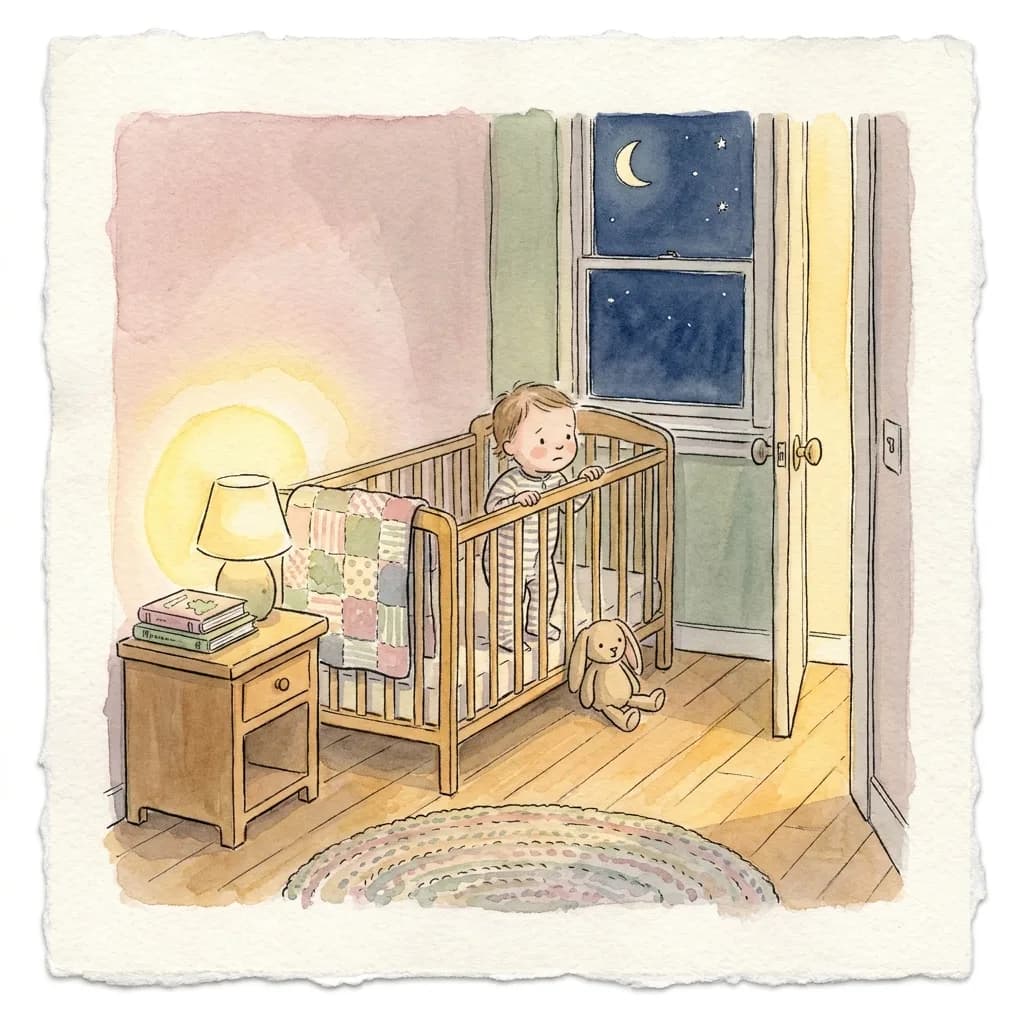
You finally had a sleeper. Bedtime took twenty minutes, the night was quiet, the nap held. Then somewhere around eighteen months it came apart. Bedtime turned into a forty-five minute stall with a kid clinging to your leg. They're up at 1 AM crying for you and not settling until you come in. The afternoon nap is shorter or refused outright.
You didn't change anything. They didn't, either, as far as you can see. The 18 month sleep regression is the catch-all parents use for the stretch of bad sleep that hits a lot of toddlers in the months around a year and a half. Whether 'regression' is the right name for it is its own question.
Is the 18 Month Sleep Regression a Real Thing?
Short answer: kind of.
The phrase 'sleep regression' is everywhere in parent-facing content and almost nowhere in the pediatric literature. Pediatric sleep researcher Jodi Mindell, after analyzing survey data from thousands of parents, found 'no specific age at which all of a sudden you see a shift in sleep' Dr. Craig Canapari, MD. The neat calendar of regressions at 4, 8, 12, 18, and 24 months that you see on parenting sites isn't really backed by a clinical evidence base.
But the underlying problem is real. A longitudinal study following more than 350 children found that about 10 percent of parents reported a sleep problem at each measurement point through the first three years, with night wakings the most common complaint in the toddler window Williamson et al., Pediatrics, NIH-PMC. Bedtime resistance and night wakings show up in roughly 20 to 30 percent of toddlers across reviews AASM Practice Parameters Review. A great sleeper falling apart at eighteen months isn't a freak case. It's a category that hits a real slice of every cohort.
The useful framing: 'regression' is a parent word for a developmental window where a few things stack and sleep takes the hit. Naming it doesn't fix it. Knowing what's behind it does. The same pattern recurs across the toddler years, and our umbrella on toddler sleep regression covers what's shared across the 18-month, 2-year, and 3-year windows.
What's Actually Happening at 18 Months
Several things tend to land within a few months of each other around the year-and-a-half mark. Any one of them is enough to wreck a bedtime routine. They often arrive together.
Language is starting to break open. The CDC's developmental milestones expect an eighteen-month-old to be trying to say three or more words besides 'mama' and 'dada,' following one-step directions without gestures, and pointing to show you things CDC, Learn the Signs. By two, that vocabulary is heading toward fifty words. The build-up takes real mental work, and some of the noise from it lands at bedtime.
Independence is suddenly the point. Eighteen months is when 'no' becomes a tool. Your kid is testing where their control ends and yours begins, and bedtime is the most obvious place that boundary lives. A kid who used to walk into the bedroom on cue now wants to choose the pajamas, the book, the order, and whether bed happens at all.
Separation anxiety can resurge. The AAP describes a wave that begins in the second half of year one and usually fades around the second birthday, with sleep often disrupted along the way: 'a child may wake several times and cry anxiously for one or both parents, often expressing a strong preference for one' AAP - HealthyChildren.org. A kid who was fine with goodnight at sixteen months can suddenly need three goodbyes at eighteen.
The nap is in flux. Most kids drop from two naps to one somewhere between thirteen and eighteen months, with the average landing around fifteen. The transition is messy. A kid who isn't ready to be on one nap will hit bedtime overtired and wired, which looks identical to a regression. A kid who's ready but still being held to two will get the second nap too close to bedtime and stall for an hour at lights out.
About the Teething Explanation
Eighteen months is in the window for the first molars, and teething gets blamed for almost any bad sleep stretch in toddlerhood. The evidence on that is weaker than parents have been told.
A 2025 study in the Journal of Pediatrics followed 849 infants and toddlers between three and eighteen months over four weeks, using crib cameras and computer vision to score sleep objectively. Parents tracked tooth eruption and symptoms the entire time. More than half reported sleep disruption during teething nights. The cameras showed no significant difference in total sleep time, night wakings, or parental crib visits between teething and non-teething nights Bruni et al., J Pediatr, 2025.
The takeaway isn't that teething doesn't hurt. It's that 'teething' explains less of what's going on at bedtime than parents assume. Treating every bad night as a tooth problem can mean giving more pain medicine than a kid actually needs. If the molars are visibly bothering them during the day, that's one thing. If you can't see anything and bedtime has been hard for two weeks, the developmental stuff above is the more likely cause.
How Long Does the 18 Month Sleep Regression Last?
Most parents see the worst of it ease within 2 to 6 weeks, which is the timeline pediatric sleep practitioners cite for developmental sleep disruption at this age.
It doesn't have to be that short, though. The same longitudinal study found that 21 to 35 percent of children with sleep problems at one measurement point still had them a year or two later, and kids with early sleep issues had three to five times the risk of ongoing sleep difficulties compared to kids without them Williamson et al., Pediatrics, NIH-PMC. The single biggest factor that turns a temporary stretch into a months-long pattern is what gets introduced to cope with it.
The Mistakes That Make It Stick
During a bad stretch, you'll do almost anything to get the kid down. Most of those moves are fine in isolation. The ones that cause trouble are the ones that quietly become permanent.
The pattern that traps parents:
- Lying down with them every night until they fall asleep
- Bringing them into your bed to end the wake-up faster
- Reviving a pacifier or bottle they'd already dropped
- Stretching the routine from 20 minutes to 60 because each new ask gets a yes
Each of those works in the moment. The problem is the next morning, when your kid has updated their model of how bedtime works. The new step is now part of the routine they expect. Whatever you added during the rough week is what you'll be undoing for the next two months.
The principle: don't introduce a sleep prop during a regression that you aren't prepared to keep. A night light or a comfort object is fine. Sleeping on their floor is a much harder undo.
What Actually Helps: Hold the Routine
The most boring advice is also the best-supported one. Keep the bedtime routine identical to what it was before everything fell apart.
Mindell's analysis of more than 10,000 families across 14 countries found a dose-dependent relationship between bedtime routine consistency and sleep Mindell et al., Sleep, 2015. The more nights per week a young child followed the same wind-down sequence, the earlier they fell asleep, the fewer times they woke at night, and the more total sleep they got. The effect held across countries and across ages from infancy through preschool. During a rough patch, that consistency is doing more work than anything else.
A routine that holds up at eighteen months looks like this:
- Screens off at least an hour before bed
- Bath or wash up
- Pajamas and teeth
- One book or audio story
- Lights out
Twenty to thirty minutes, same order, every night. If you don't have one yet, our guide to building a toddler bedtime routine walks through what to keep and what to drop. For the audio story slot, our bedtime stories app has multi-character narrated stories built for this age — Taylor's Quiet Shell walks through a slow-breathing reset for the kind of overstimulated wind-down that 18-month-olds bring to bed.
A few mechanical adjustments pair well with holding the routine:
- Pull bedtime earlier by 15 to 30 minutes if your kid is overtired by the time the routine starts
- Watch the second nap if you're still doing two. A nap that ends after 3 PM eats into bedtime
- Don't force the one-nap transition before they're ready. Most kids land there between 15 and 18 months but some hold on longer
- Dim the lights through the routine. A 2022 study found that an hour of evening light exposure suppressed melatonin in toddler-aged kids by an average of 85 percent <a href="https://pubmed.ncbi.nlm.nih.gov/34997782/">Hartstein et al.
- J Pineal Research
- 2022</a>
None of these need willpower from your kid. They lower the biological resistance to sleep before you get to the bedtime conversation. If you're already stuck in nightly fights, the post on toddlers fighting bedtime covers what's behind them and what helps. And if the trouble at eighteen months feels like it's coming from somewhere else, our walk-through of the 2 year sleep regression covers what to look for as you head into year two.
When It's Not a Regression
Some of what looks like a regression is something else. A few patterns are worth a closer look with your pediatrician AAP - HealthyChildren.org:
- Loud snoring or mouth breathing every night
- Visible pauses in breathing during sleep
- Wake-ups at the same exact time every night (more typical of an environmental trigger than a developmental one)
- Severe distress at bedtime lasting beyond 6 weeks and starting to affect daytime mood
- Daytime sleepiness that doesn't improve when total sleep does
For everything else, the playbook hasn't moved. Hold the routine. Don't add anything you can't keep. Give it time. Most 18 month sleep regressions resolve on their own within a few weeks. The kids who come out of them sleeping well are the ones whose parents kept the bedtime they already had.
