
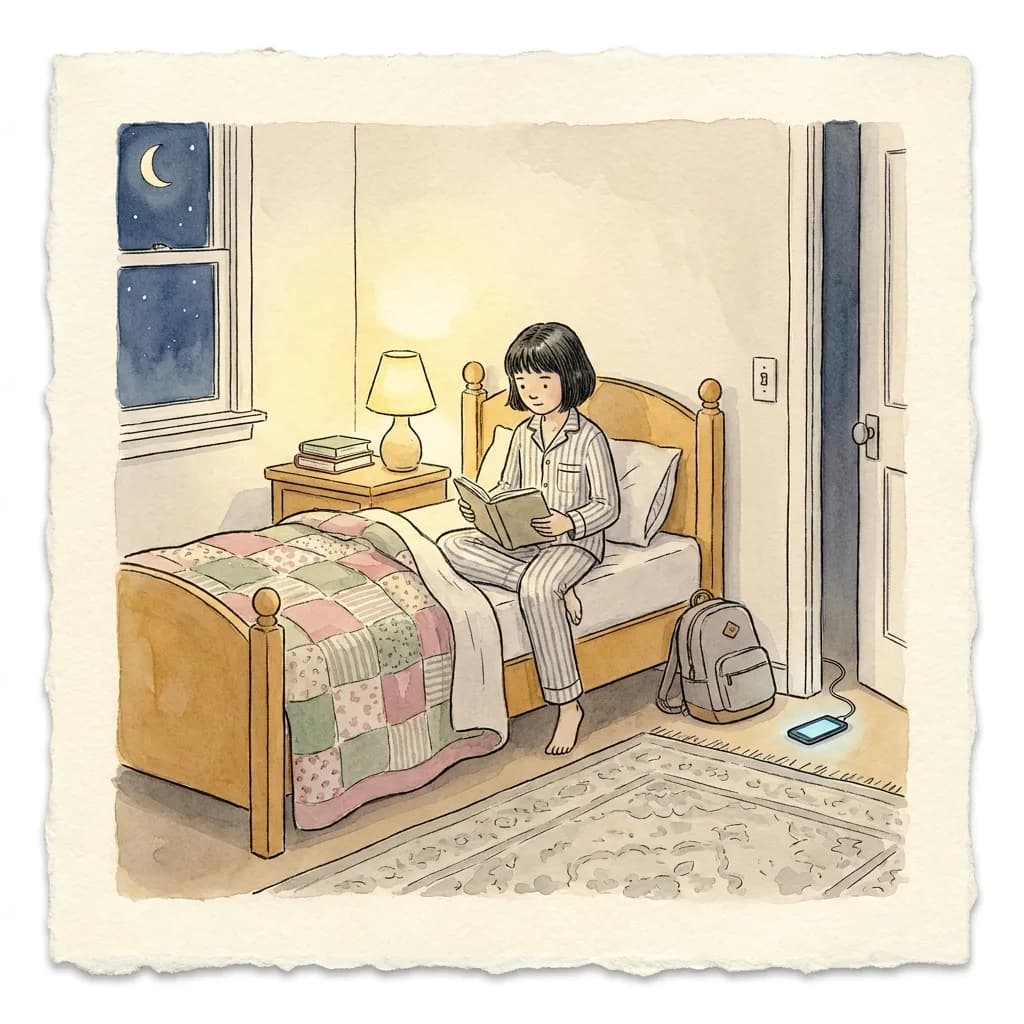
What Time Should a 12 Year Old Go to Bed? A Wake-Time Guide
Most 12-year-olds who wake between 6:30 and 7:00 AM need lights out around 8:30 to 9:00 PM. Use this wake-time guide to set the clock and adjust it.
The quick answer
A 12-year-old who wakes between 6:30 and 7:00 AM should usually start with lights out between 8:30 and 9:00 PM. That allows 10 hours in bed, which sits inside the 9 to 12 hours the American Academy of Sleep Medicine recommends for children ages 6 to 12 AASM pediatric sleep recommendations.
That time is a starting point, not a universal curfew. If your child needs 30 minutes to fall asleep, begin the routine early enough that the 10-hour calculation starts when sleep usually begins. If they wake earlier for school, move lights out earlier too. The morning sets the bedtime math.
Count backward from the morning
Start with the required wake-up time, then count backward by 10 hours. Ten hours gives you a practical first schedule inside the recommended range. Your child may need more or less than that, but the calculation makes the first week easy to test.
Here is the school-night math:
- 6:00 AM wake-up: 8:00 PM lights out allows 10 hours in bed
- 6:30 AM wake-up: 8:30 PM lights out allows 10 hours in bed
- 7:00 AM wake-up: 9:00 PM lights out allows 10 hours in bed
- 7:30 AM wake-up: 9:30 PM lights out allows 10 hours in bed
Time in bed and time asleep are different. A child who turns out the light at 9:00 but talks, reads, or lies awake until 9:40 has a 9-hour-and-20-minute sleep opportunity before a 7:00 alarm. Track when sleep seems to begin, not only when the bedroom door closes.
Twelve is still in the 9-to-12-hour group
Age 12 sits at the top of the AASM's 6-to-12 bracket, so the recommendation is still 9 to 12 hours per 24 hours. At 13, the published range changes to 8 to 10 hours AASM.
The thirteenth birthday does not automatically earn a later bedtime. If the morning alarm stays at 6:30, a 13-year-old still needs lights out early enough to get at least eight hours, and many will do better closer to nine or ten. Move the clock because the child's sleep and morning have changed, not because the date did.
For a younger sibling, the same wake-time method works with a different target. Our 9-year-old bedtime guide uses the same calculation while keeping the 9-to-12-hour range in view.
A later body clock does not cancel an early alarm
Bedtime can become harder around middle school even when the family has not changed the rules. The American Academy of Pediatrics reports that puberty shifts many adolescents toward later sleep and wake times. Its school-start policy describes a phase delay of up to two hours compared with middle childhood AAP school-start policy.
That shift explains why an 8:30 bedtime can feel early to a 12-year-old. It does not add time to the morning. The same AAP policy identifies school starts before 8:30 AM as a major contributor to insufficient sleep among middle and high school students.
If your child lies awake most nights, do not turn bedtime into a two-hour argument. Keep the wake time steady, move lights out in 15-minute steps, and watch the total sleep opportunity. A schedule that looks perfect on paper but produces a long nightly struggle needs a small adjustment, not a lecture.
Keep weekends close enough to protect Sunday night
Middle-school weekends can run later than school nights. The useful boundary is the morning. The AAP advises keeping weekend wake-ups within about an hour of the usual time so a child's sleep phase does not shift enough to make the school schedule hard again AAP school-age bedtime routines.
A special late night is not a broken schedule. Repeatedly sleeping until noon is what makes Sunday night and Monday morning rough. Keep the usual wake time visible, allow some flexibility, then return to the school-night lights-out time before the week starts.
Give them ownership without handing over the clock
At 12, the routine should not look like a preschool checklist managed by a parent. The AAP recommends stepping back as children get older and letting them take more responsibility, while keeping the routine manageable and generally no longer than 30 minutes HealthyChildren.org.
Set the two boundaries that affect sleep: when the phone parks for the night and when lights go out. Let your child own the steps in between.
- Pack the school bag and set out anything needed in the morning
- Shower or wash up and brush teeth
- Park the phone outside the bedroom
- Read or listen or draw or talk quietly
- Lights out at the agreed time
Bedtime stories do not have to be mandatory at 12. Some tweens still like an audio story, while others want a chapter book or quiet music. If a younger sibling shares the last few minutes, Fair Pair Adventure gives different bedtimes a useful frame: fair does not always mean identical.
The basic rhythm from a toddler bedtime routine still applies years later. Repeat a short sequence and end clearly. The difference is that the 12-year-old should run most of it.
Put the phone somewhere boring
A phone on the nightstand turns every alert into a new bedtime decision. The AAP recommends avoiding screens for one hour before bed and keeping televisions, computers, and smartphones out of children's bedrooms overnight AAP media guidance.
Pick one charging spot outside the bedroom and use it every night. Turn on do-not-disturb before the phone goes there. If homework needs a screen, set a stopping time and move the final offline task, packing a bag or choosing clothes, into the last part of the routine.
A quiet audio story can be queued before the phone is parked. The Gushi story library lets a child choose by theme, then listen without holding the screen through the whole story.
Adjust from a week of real sleep
A regular bedtime is not unusually strict for this age. In the 2024 National Health Interview Survey, 87.4% of children ages 11 to 13 had a regular bedtime most days or every day CDC National Center for Health Statistics.
Test the calculated bedtime for one school week. Write down lights out, the best estimate of sleep onset, wake-up time, and whether waking required repeated alarms. You need a pattern, not perfect tracking.
If sleep keeps starting too late to leave nine hours before the alarm, move the routine 15 minutes earlier. If your child lies awake for a long stretch but wakes rested and functions well, try 15 minutes later while protecting the minimum range. Keep changes small enough that you can tell what worked.
Talk with your pediatrician if snoring, breathing trouble, ongoing insomnia, or heavy daytime sleepiness persists. The CDC recommends contacting a health care provider when sleep problems or signs of a sleep disorder continue CDC sleep guidance.
For a 6:30 to 7:00 AM wake-up, 8:30 to 9:00 PM is the cleanest starting range. Count backward from morning, protect enough time for sleep, and adjust from what your child actually does.
